THE CRYSTALLINE SPONGE METHOD
The host provides
the order.
The crystalline sponge method determines molecular structures by single-crystal X-ray diffraction without requiring the target molecule to crystallize on its own.
The target is introduced into a crystalline host. The host captures and orders the guest, allowing its three-dimensional structure to be resolved from the diffraction data.
FIRST GENERATION
2013NatureA preformed porous crystal provides the order.
Introduced by Inokuma and colleagues in Makoto Fujita’s group in 2013, the first-generation method uses a preformed porous coordination-network crystal. Guest molecules enter its pores and are held in ordered positions for X-ray diffraction.
Inokuma, Y. et al. X-ray analysis on the nanogram to microgram scale using porous complexes. Nature 2013, 495, 461–466.
Read the original 2013 paper →SECOND GENERATION
2025Nature ChemistryA coordination cage provides the order.
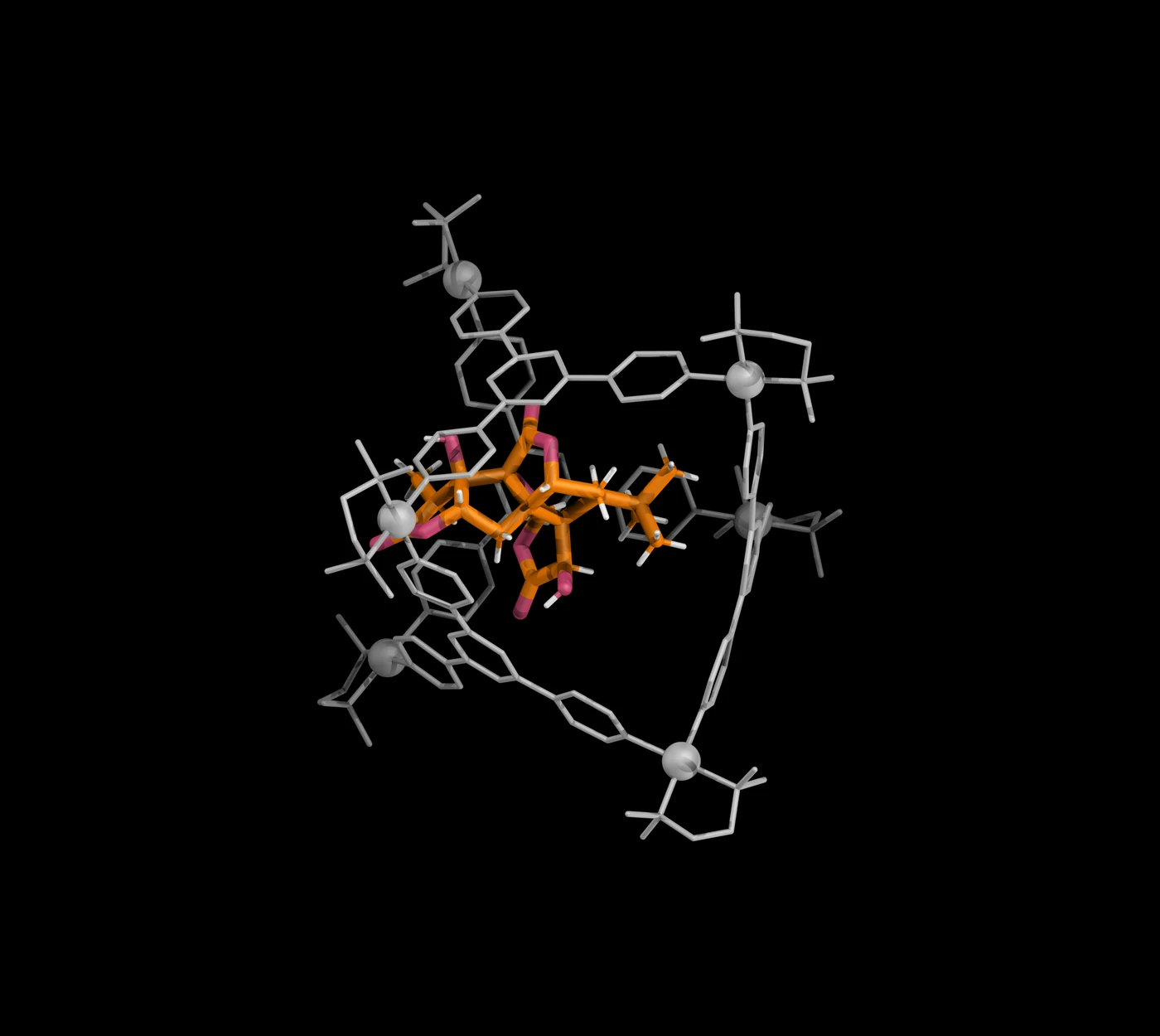
Reported in 2025 in Nature Chemistry, the second-generation method uses a discrete coordination cage as the host. The cage captures or associates with a guest, while crystal packing fixes the host–guest assembly in an ordered lattice suitable for diffraction.
The 2026 study in Angewandte Chemie International Edition advances this platform toward consistent structure analysis under standardized conditions across diverse molecules.