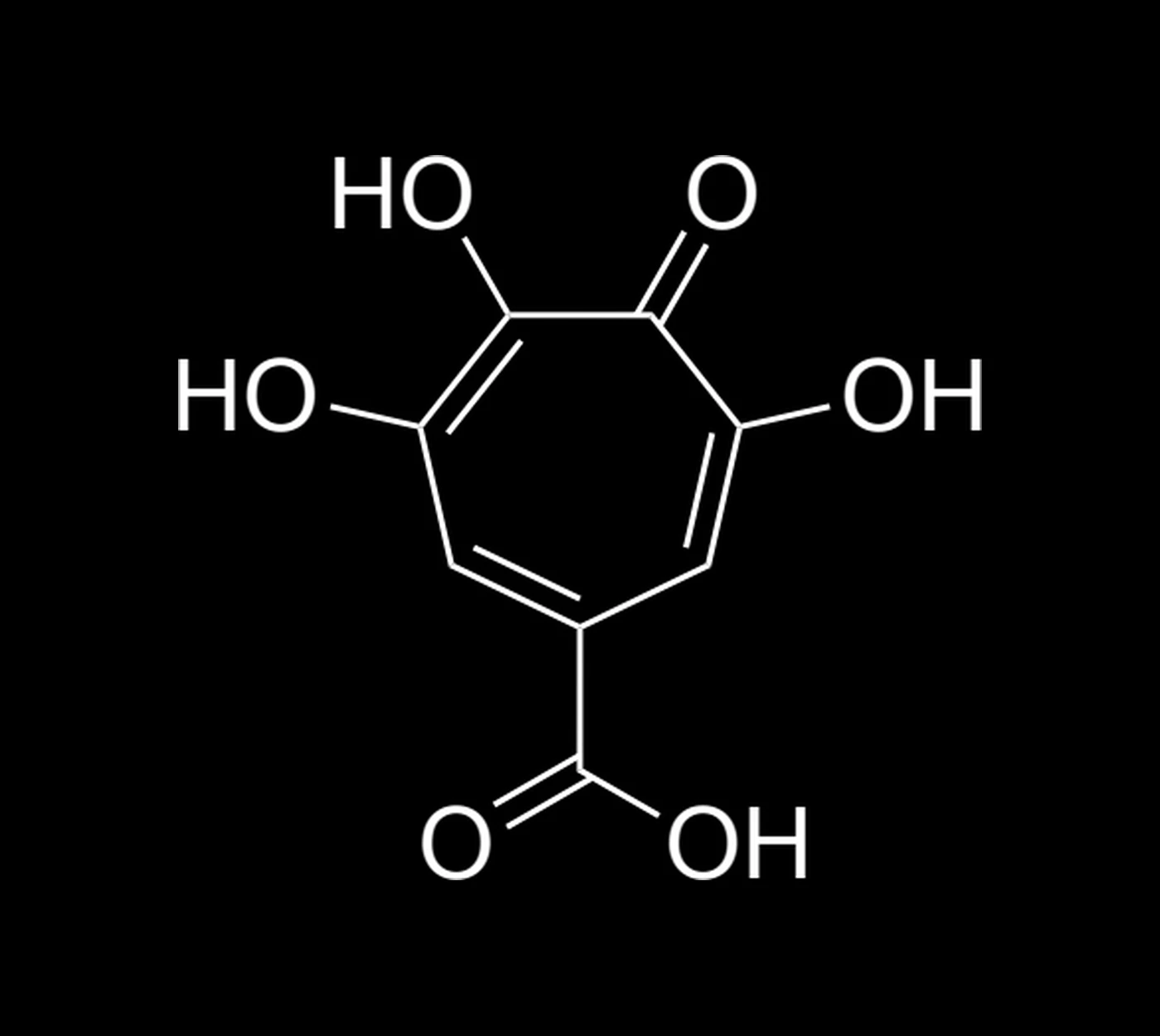
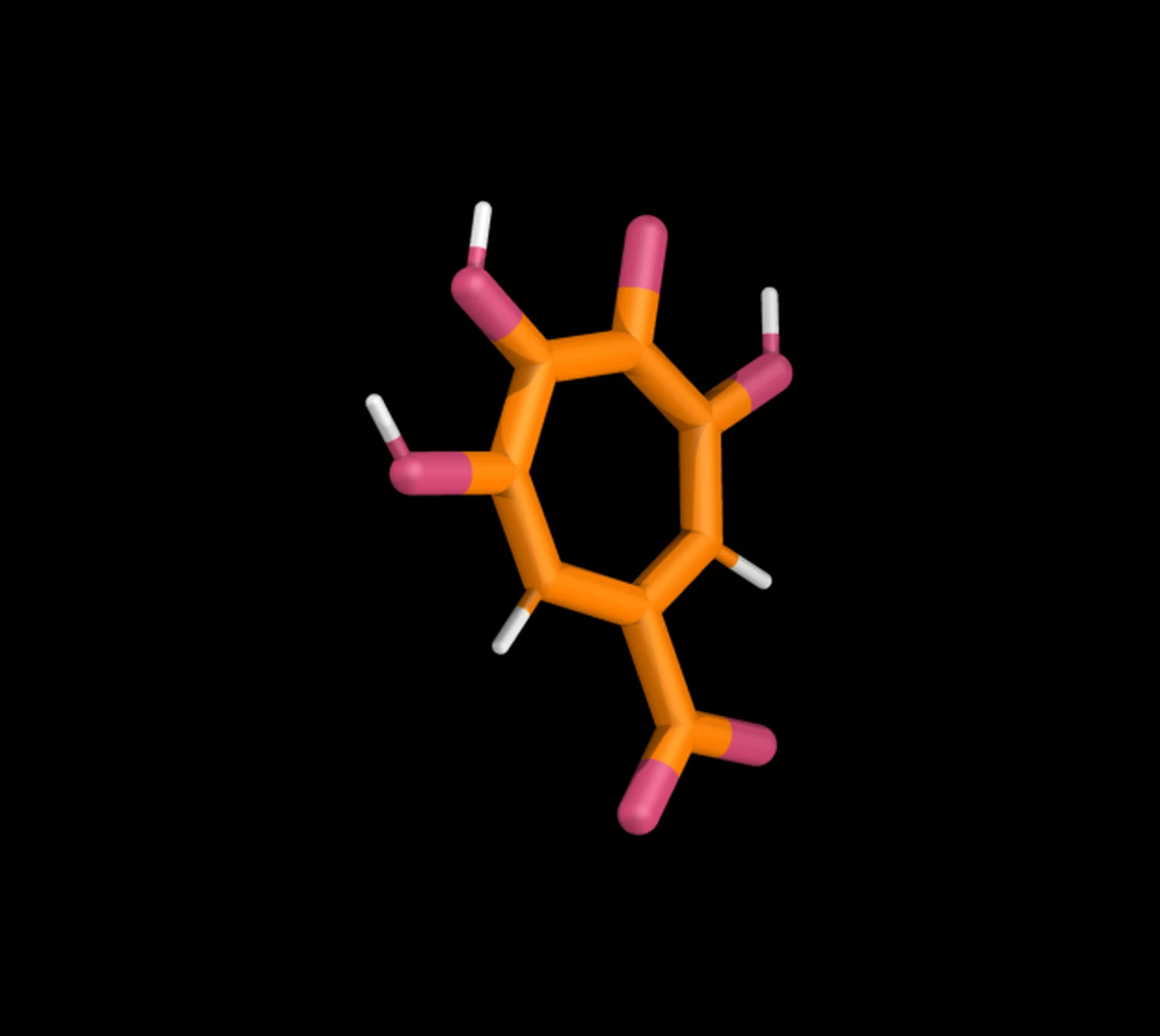
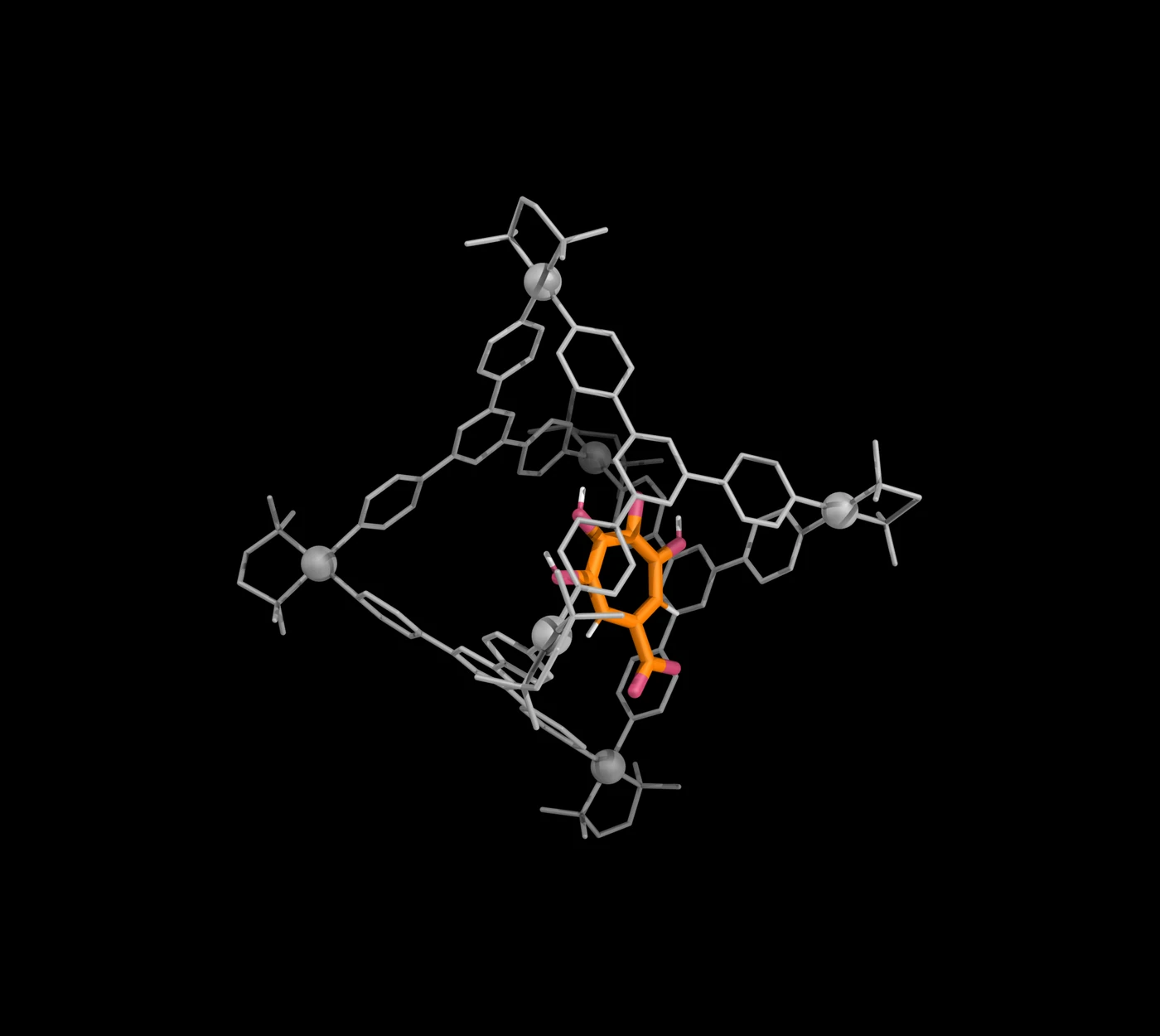
Puberulic acid resolved by the crystalline-sponge method.
A deceptively small fungal tropolone with an unusually long history of structural and synthetic investigation.
G043 · Tropolone derivative
C8H6O6 · 198.13 g mol−1
First crystal structure · Angewandte Chemie International Edition 2026 · compound 32 →
INTERACTIVE 3D STRUCTURE
Drag to rotate, scroll to zoom, switch the cage on or off, and export the current view.
Puberulic acid resolved by the crystalline-sponge method.
A deceptively small fungal tropolone with an unusually long history of structural and synthetic investigation.
MOLECULAR HISTORY
Puberulic acid is a highly oxygenated tropolone metabolite. Its compact formula conceals an unusual electronic structure that made it important to the emergence of non-benzenoid aromatic chemistry.
Birkinshaw and Raistrick isolated puberulic acid from the metabolic products of Penicillium puberulum and established its empirical composition.1
Corbett, Johnson and Todd connected puberulic acid with the then-new chemistry of tropolones, rationalizing its unusual acidity and reactivity through a seven-membered conjugated ring.2
A protecting-group-free, eight-step synthesis from commercially available material delivered puberulic acid in 54% overall yield and provided a modern chemical confirmation of its connectivity.3
The crystalline sponge ordered the native metabolite sufficiently for single-crystal X-ray analysis, furnishing its first definitive crystallographic structure.4
WHY THIS STRUCTURE MATTERS
Chemical degradation, spectroscopy and total synthesis had built a persuasive structural case, but the native metabolite still lacked direct crystallographic confirmation. The crystalline-sponge result closes that long-standing gap.
SOURCE PUBLICATION
Angewandte Chemie International Edition 2026
DOI 10.1002/anie.202524615 ↗