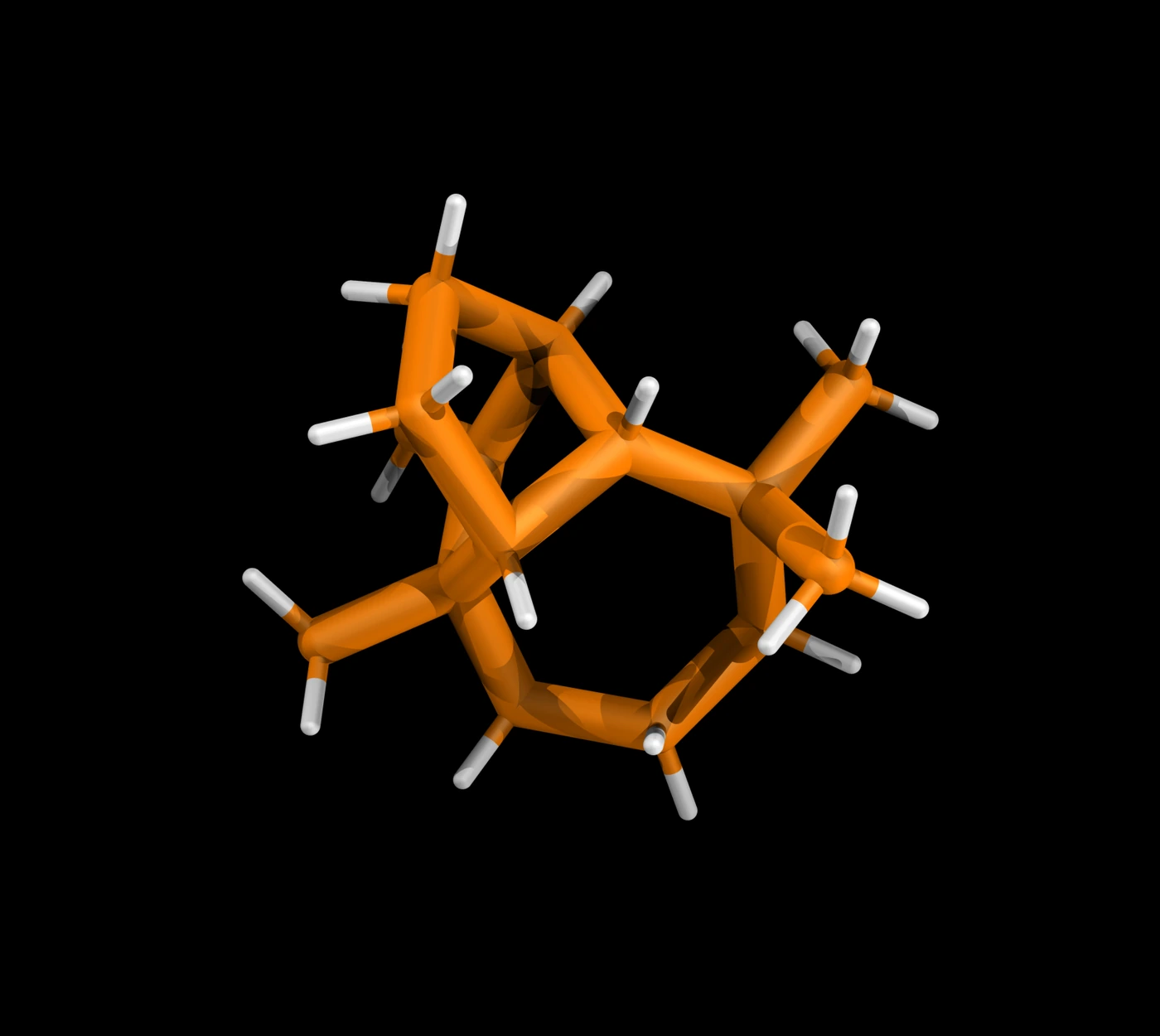
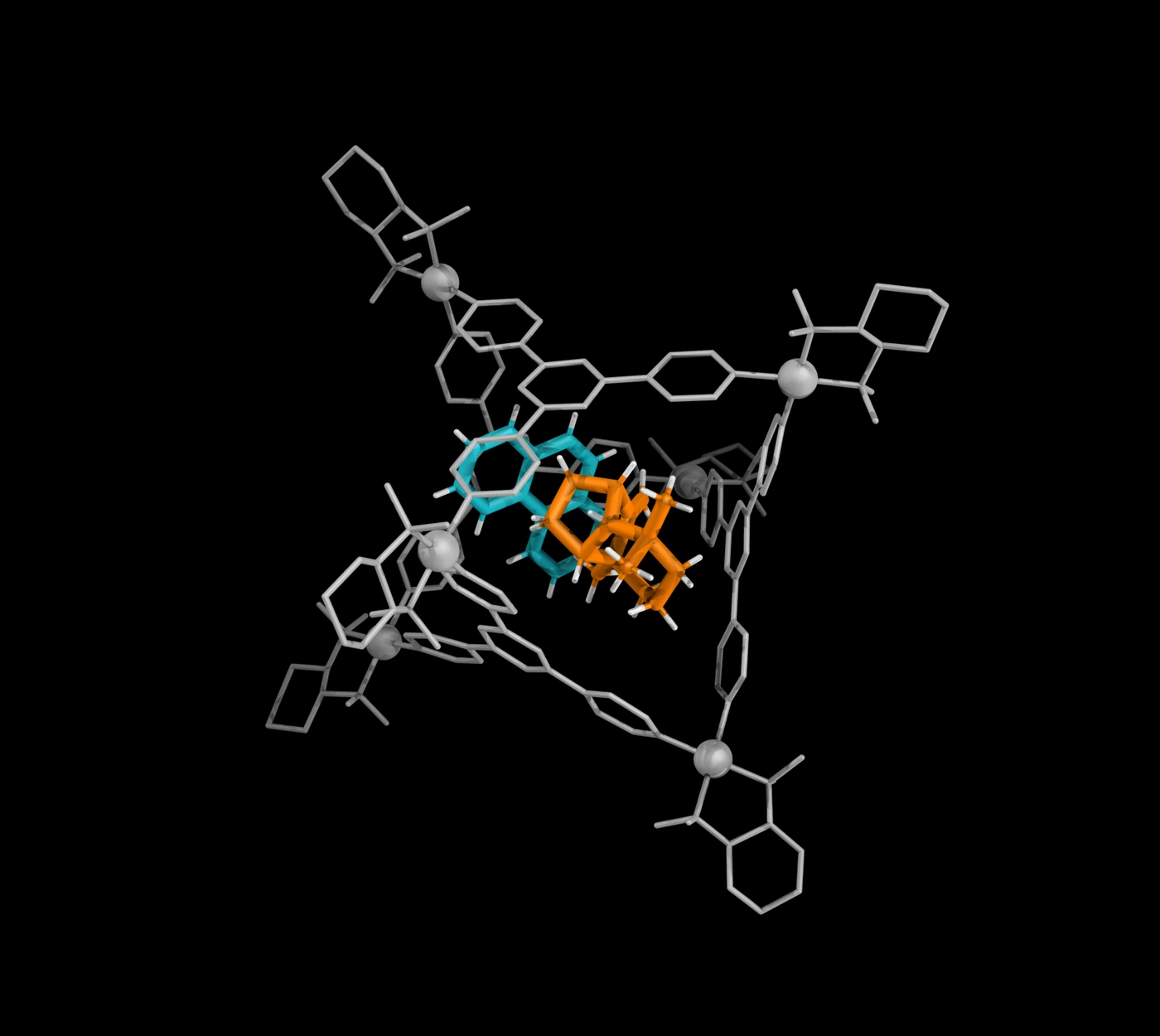
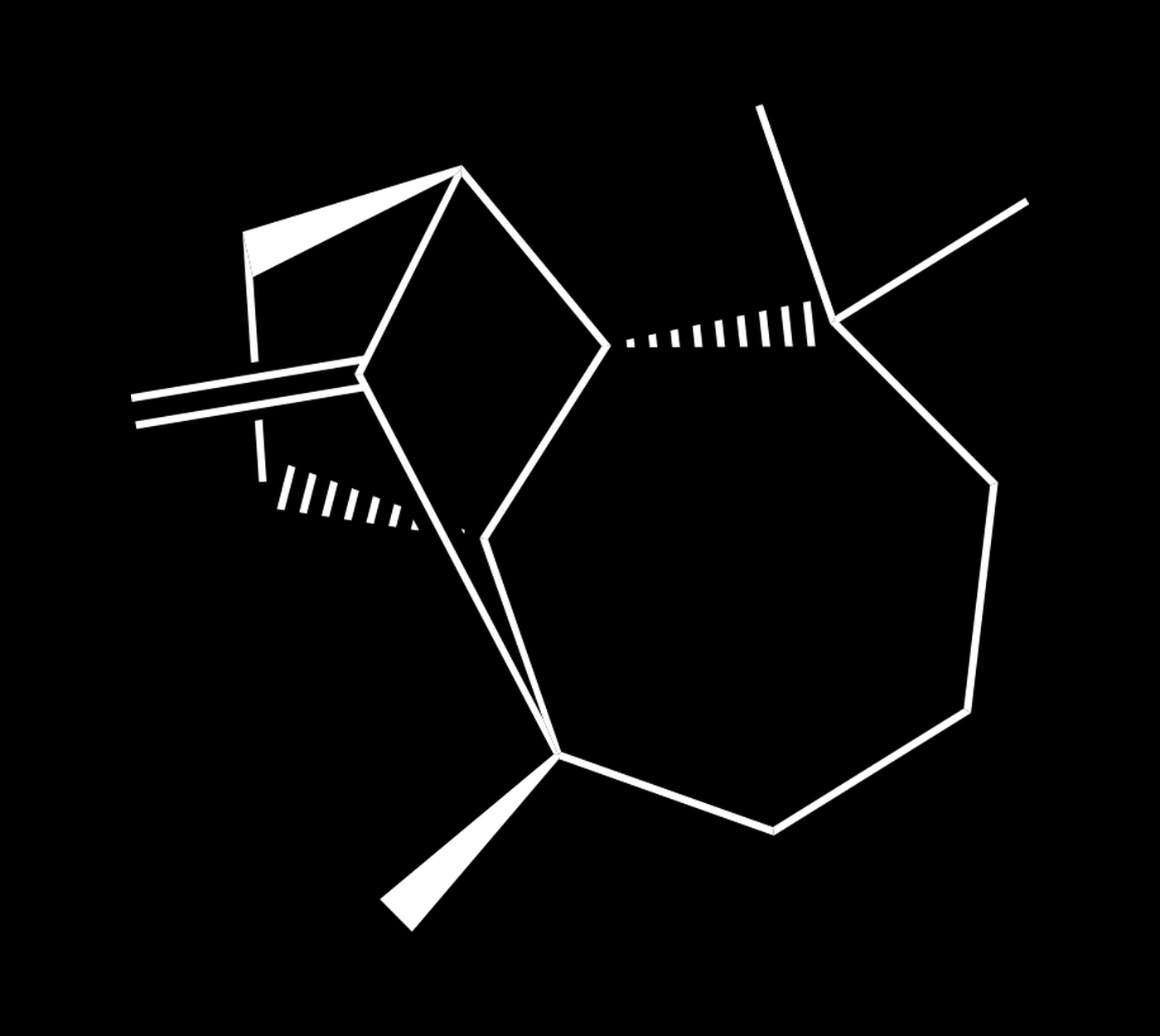
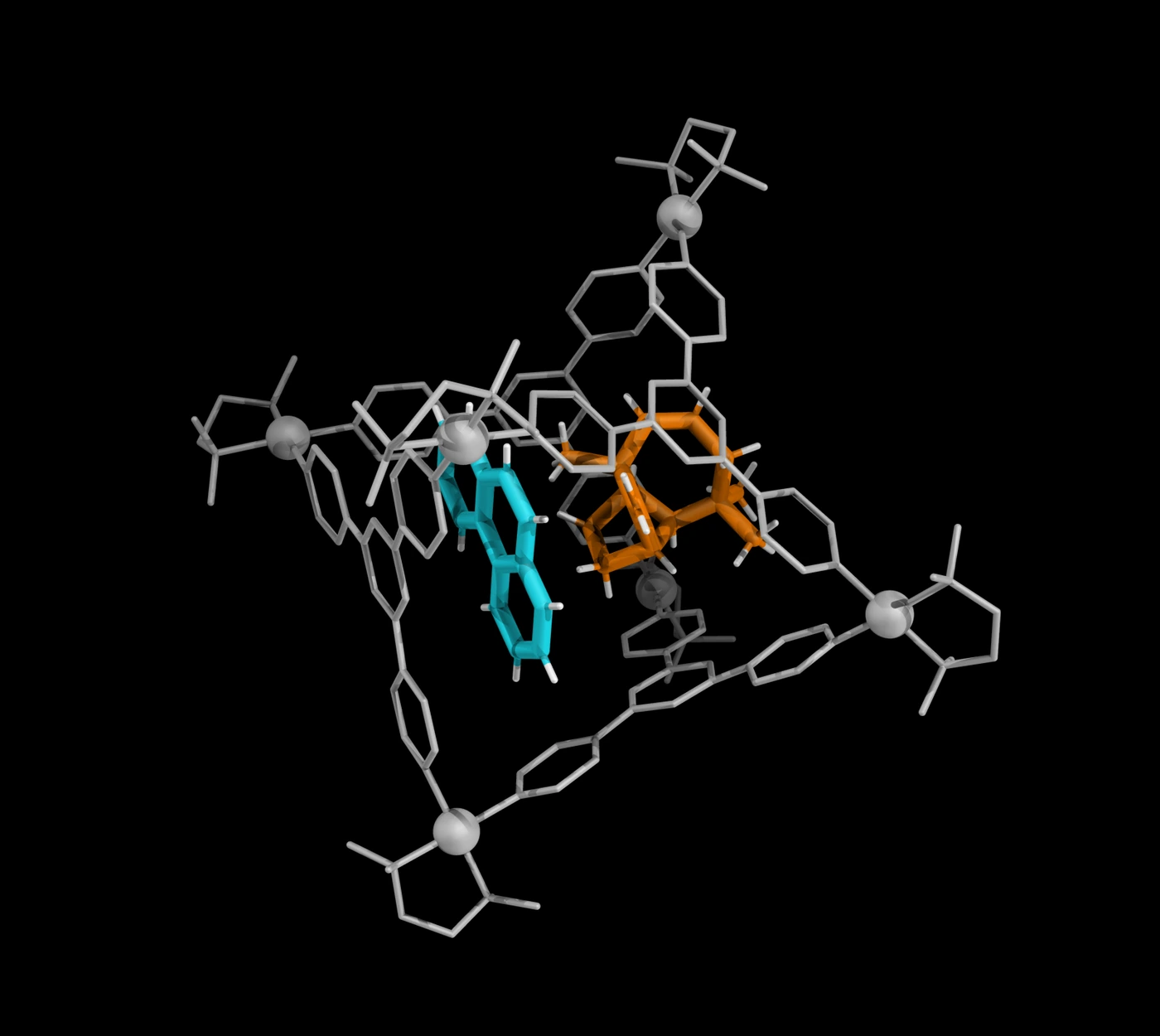
(+)-Longifolene (compound 4) was structurally analyzed using cage 1a and phenanthrene (2a) in the size-compensation strategy for low-polarity small molecules.
G074 · Sesquiterpenoid
(+)-Longifolene
C15H24 · 204.36 g mol−1
First crystal structure · Reported for the unmodified analyte in this study → · Read the story ↓
INTERACTIVE 3D STRUCTURE
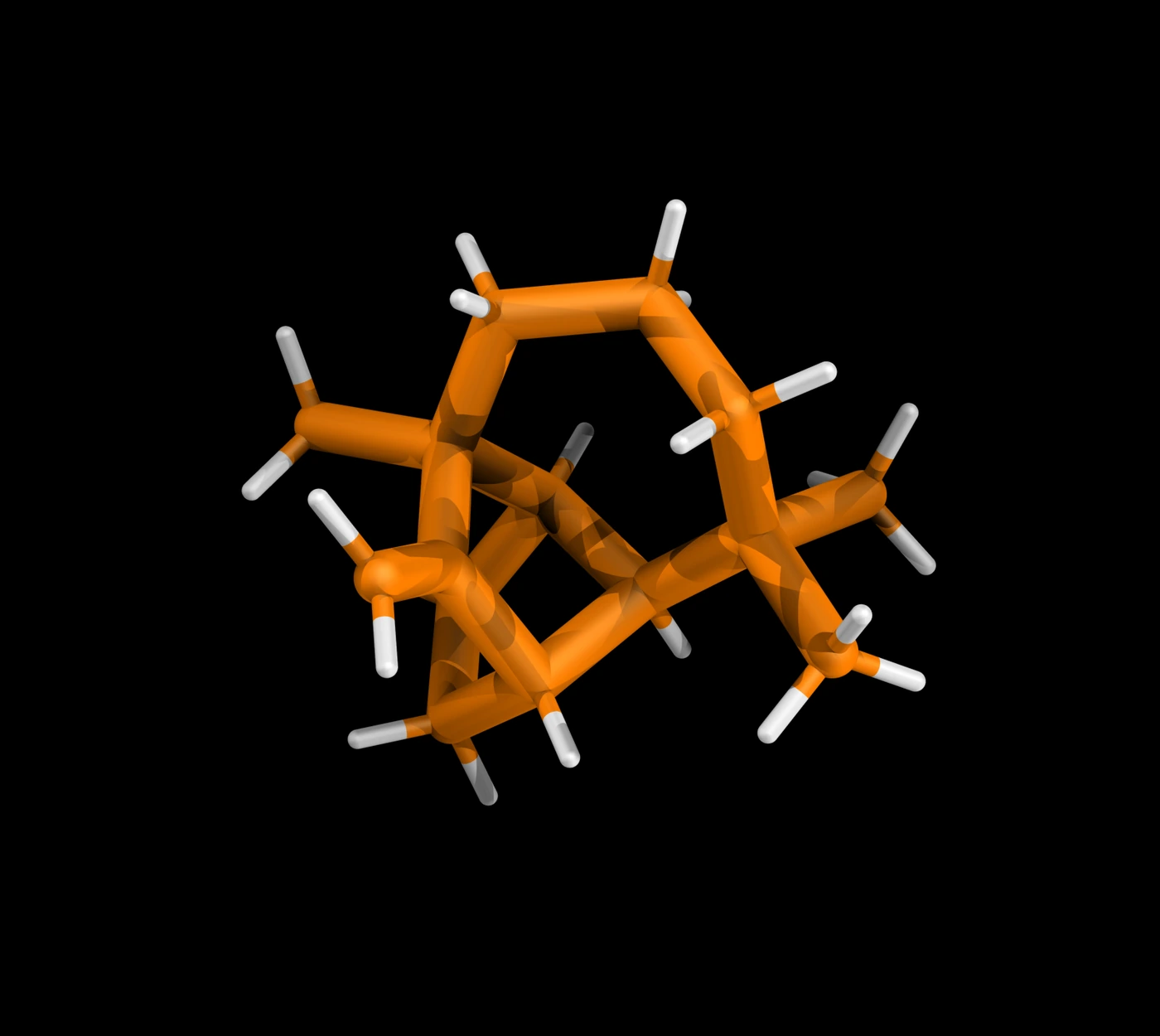
Explore (+)-Longifolene in its crystalline sponge
Drag to rotate, scroll to zoom, switch the cage on or off, and export the current view.
CHONCagePhenanthrene 2a
- Molecular formula
- C15H24
- Molecular weight
- 204.36 g mol−1
- CCDC accession
- 2565726 ↗
- Host
- Pd6L4 cage 1a
- Compound in publication
- 4
MOLECULAR HISTORY
From Indian turpentine to an unmodified crystal structure
Longifolene entered the literature in 1920, but its compact, bridged skeleton kept chemists busy for decades. Synthesis established routes to the molecule and crystallography examined a hydrochloride derivative. More than a century later, the unchanged hydrocarbon itself is resolved in a host crystal.
- 1920
- 1964
Building the bridged skeleton
Corey and colleagues published a full account of their longifolene synthesis. A ring-expansion sequence and internal cyclization assembled its demanding bridged framework, showing how the known molecular architecture could be constructed deliberately in the laboratory.2
- 1965
Crystallography through a derivative
Cesur and Grant reported the crystal structure of longifolene hydrochloride. This was crystallographic evidence for a chemically modified derivative; it did not provide the crystal structure of the unchanged C15H24 hydrocarbon examined in the present gallery.3
- 2026
The unchanged molecule becomes visible
More than a century after isolation, phenanthrene helps hold unmodified longifolene inside cage 1a for X-ray analysis. The published study reports its first crystal structure; a second experiment in chiral cage 1b strengthens the assignment of its absolute configuration.4
WHY THIS STRUCTURE MATTERS
After a century of isolation, synthesis and derivative crystallography, the host–guest structure records the unmodified longifolene framework directly. Chiral cage 1b adds an internal stereochemical reference that strengthens its absolute-configuration assignment.
References
- J. L. Simonsen. “LXI.—The constituents of Indian turpentine from Pinus longifolia, Roxb. Part I.” J. Chem. Soc., Trans. 1920, 117, 570–578. DOI 10.1039/CT9201700570 ↗
- E. J. Corey; M. Ohno; R. B. Mitra; P. A. Vatakencherry. “Total Synthesis of Longifolene.” J. Am. Chem. Soc. 1964, 86, 478–485. DOI 10.1021/ja01057a039 ↗
- A. F. Cesur; D. F. Grant. “The crystal structure of longifolene hydrochloride.” Acta Crystallogr. 1965, 18, 55–59. DOI 10.1107/S0365110X65000099 ↗
- W. He; L. Soliman; H. Takezawa; M. Fujita. “Expanding the Chemical Space of Analytes in the 2G Crystalline Sponge Method: Size-Compensation Strategy for the Structural Analysis of Low-Polarity Small Molecules.” Angew. Chem. Int. Ed. 2026, e4748505. DOI 10.1002/anie.4748505 ↗
Crystal records in this study
| Host | Modulator | CCDC | SI table |
|---|---|---|---|
| Standard cage 1a | Phenanthrene 2a | 2565726 | S1 |
SOURCE PUBLICATION
Expanding the Chemical Space of Analytes in the 2G Crystalline Sponge Method: Size-Compensation Strategy for the Structural Analysis of Low-Polarity Small Molecules
W. He, L. Soliman, H. Takezawa, M. Fujita
Angew. Chem. Int. Ed. 2026, e4748505.
First published: 20 October 2026 · Early View
DOI 10.1002/anie.4748505 ↗Enhanced absolute-configuration determination
The known absolute configuration of the chiral diamine ligand at each Pd center of the cage serves as an internal stereochemical reference for comparison with the guest. Introducing chirality into the host framework also improves absolute-structure discrimination by anomalous scattering, as assessed by the Flack parameter below.
Chiral cage 1b · CCDC 2565757 ↗
Flack x = 0.070(4) (Parsons; CIF)