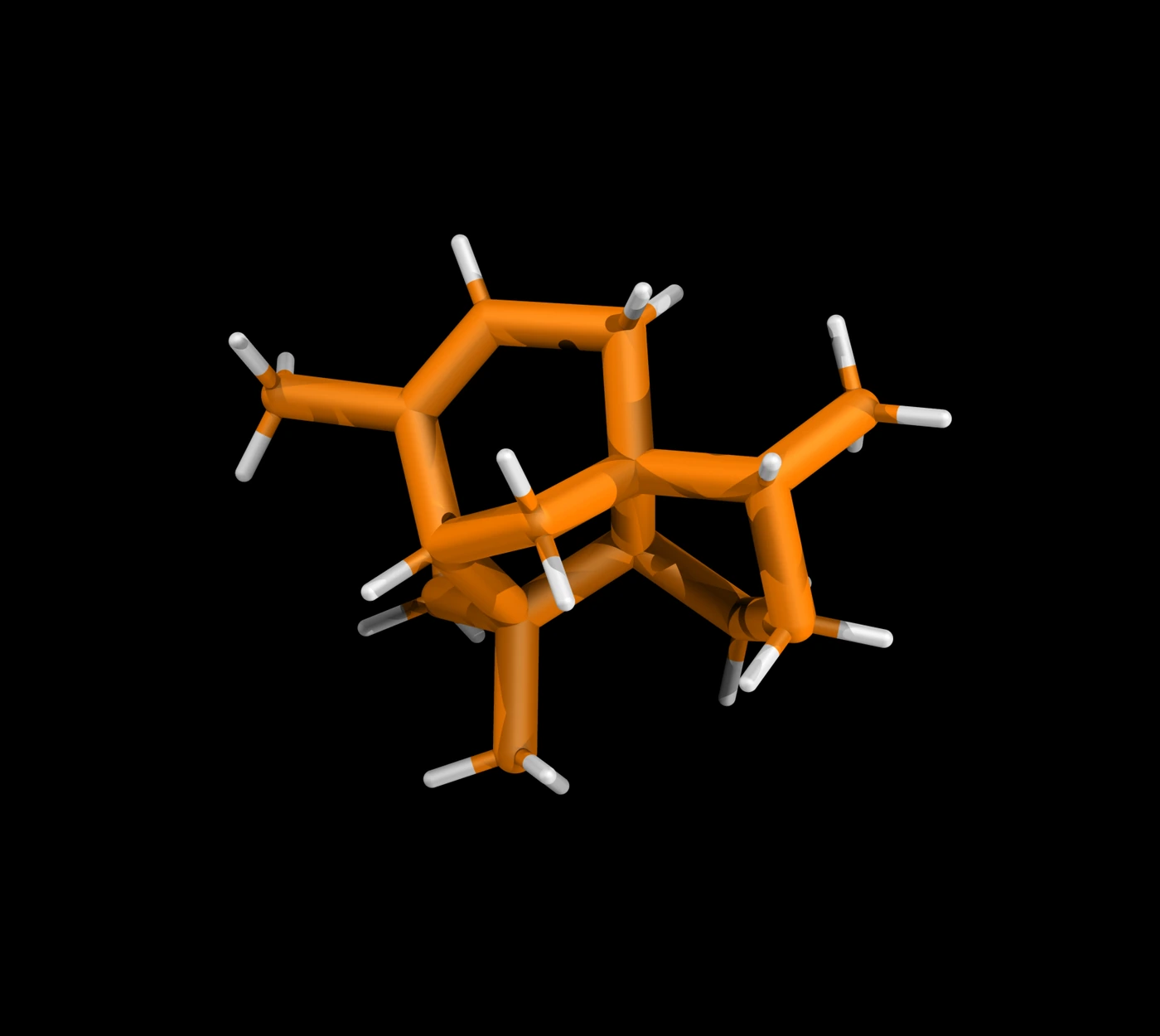
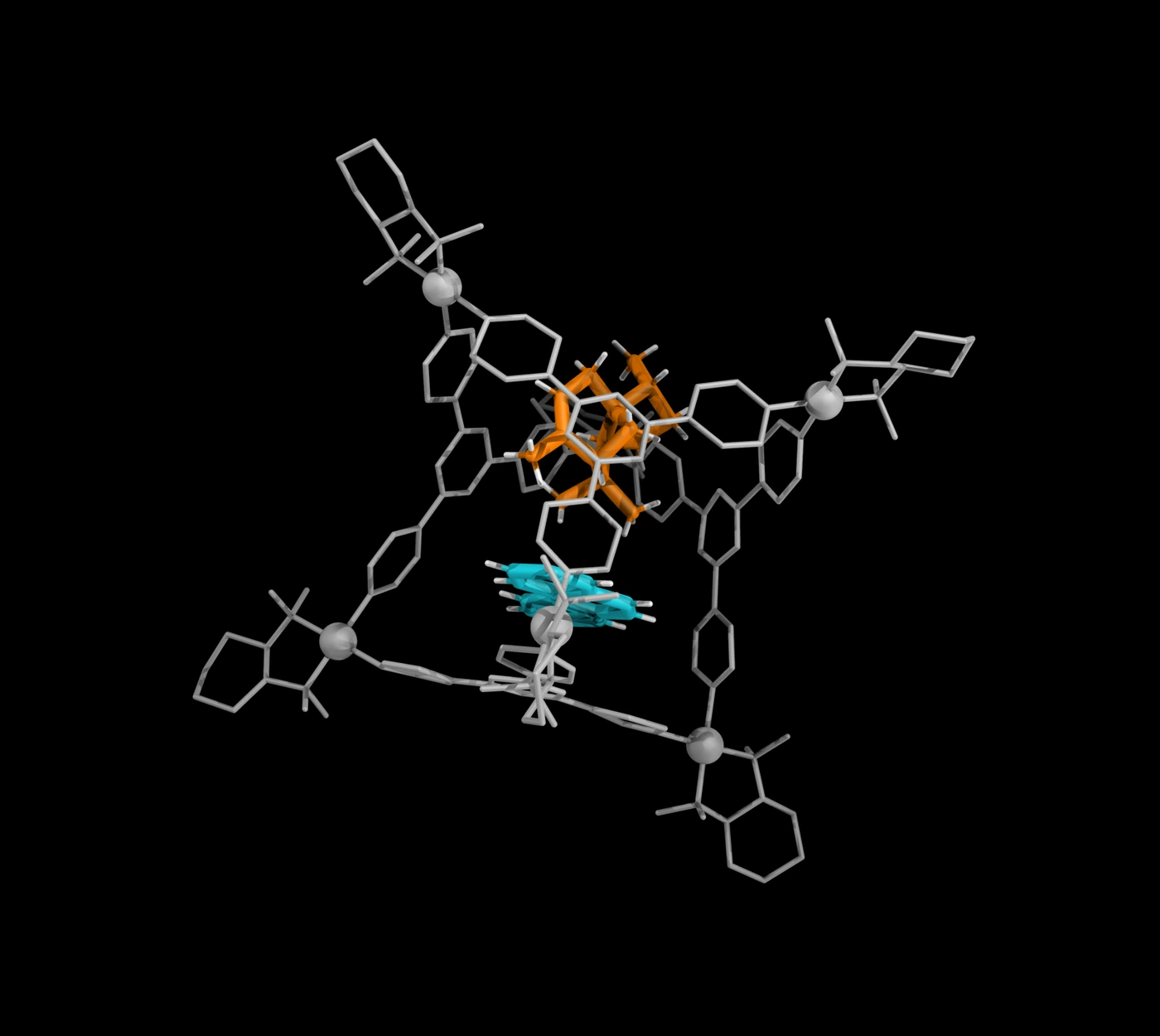
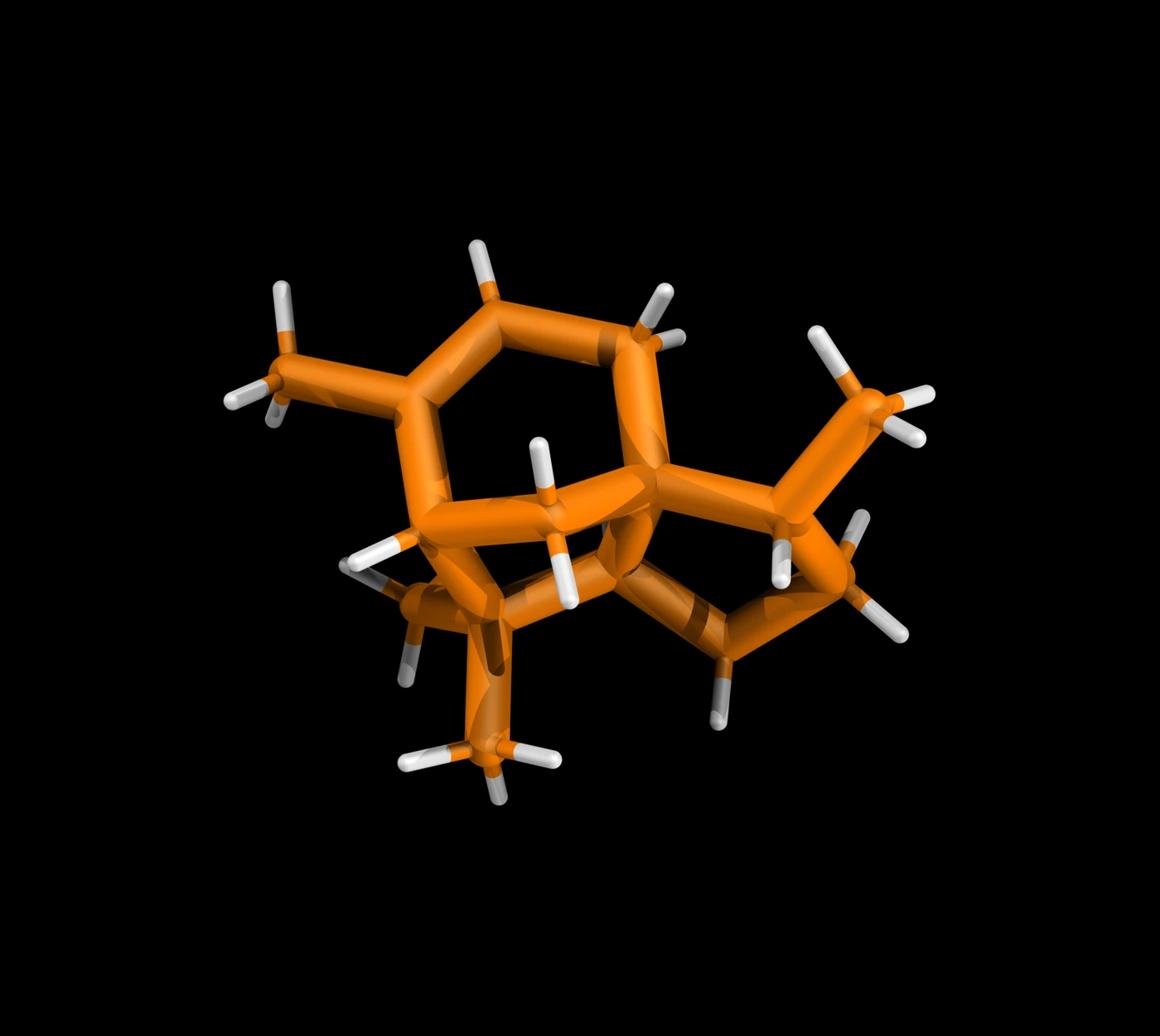
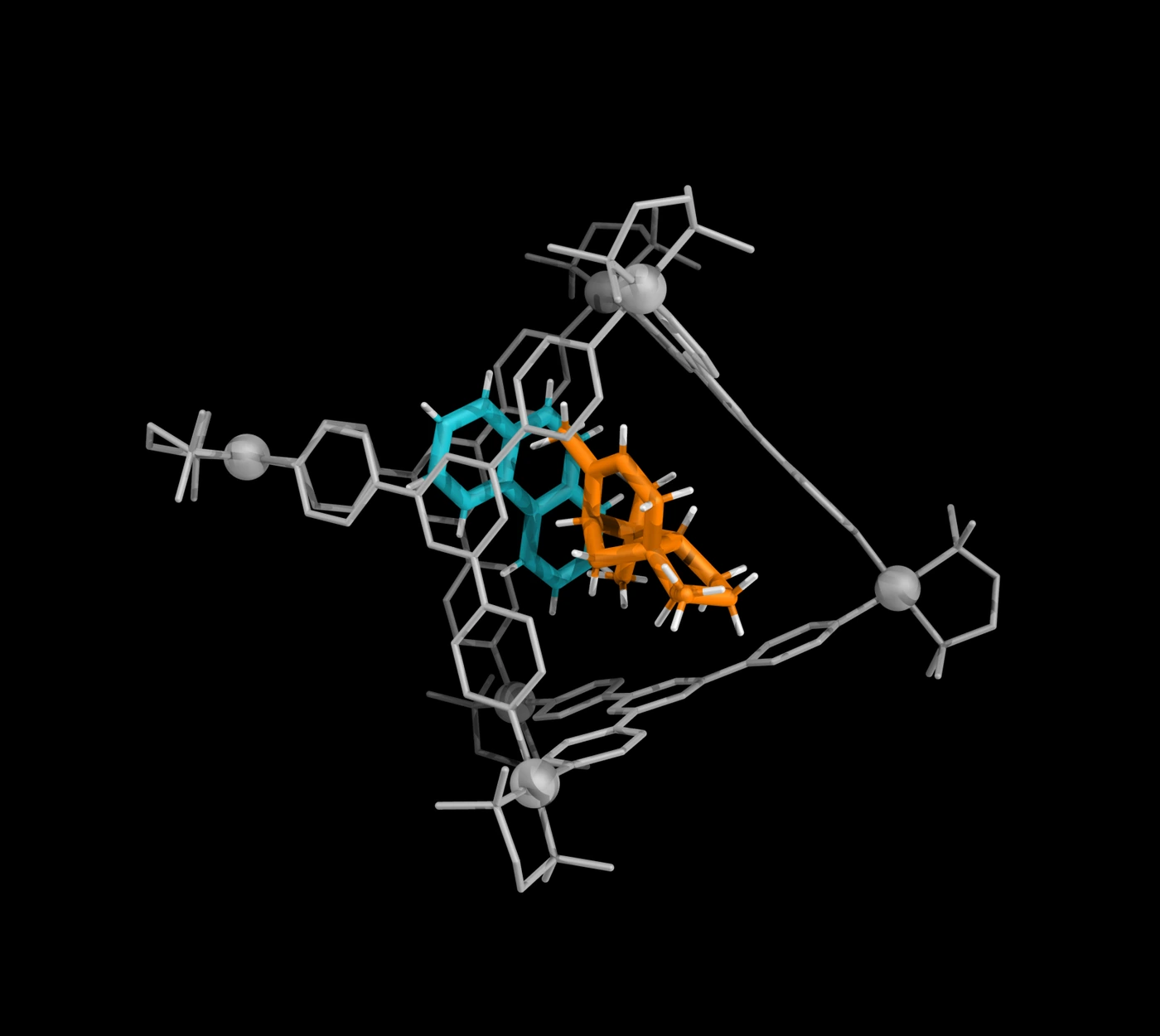
(−)-Cedrene (compound 5) was structurally analyzed using cage 1a and phenanthrene (2a) in the size-compensation strategy for low-polarity small molecules.
G075 · Sesquiterpenoid
(−)-Cedrene
C15H24 · 204.36 g mol−1
First crystal structure · Reported for the unmodified analyte in this study → · Read the story ↓
INTERACTIVE 3D STRUCTURE
Explore (−)-Cedrene in its crystalline sponge
Drag to rotate, scroll to zoom, switch the cage on or off, and export the current view.
CHONCagePhenanthrene 2a
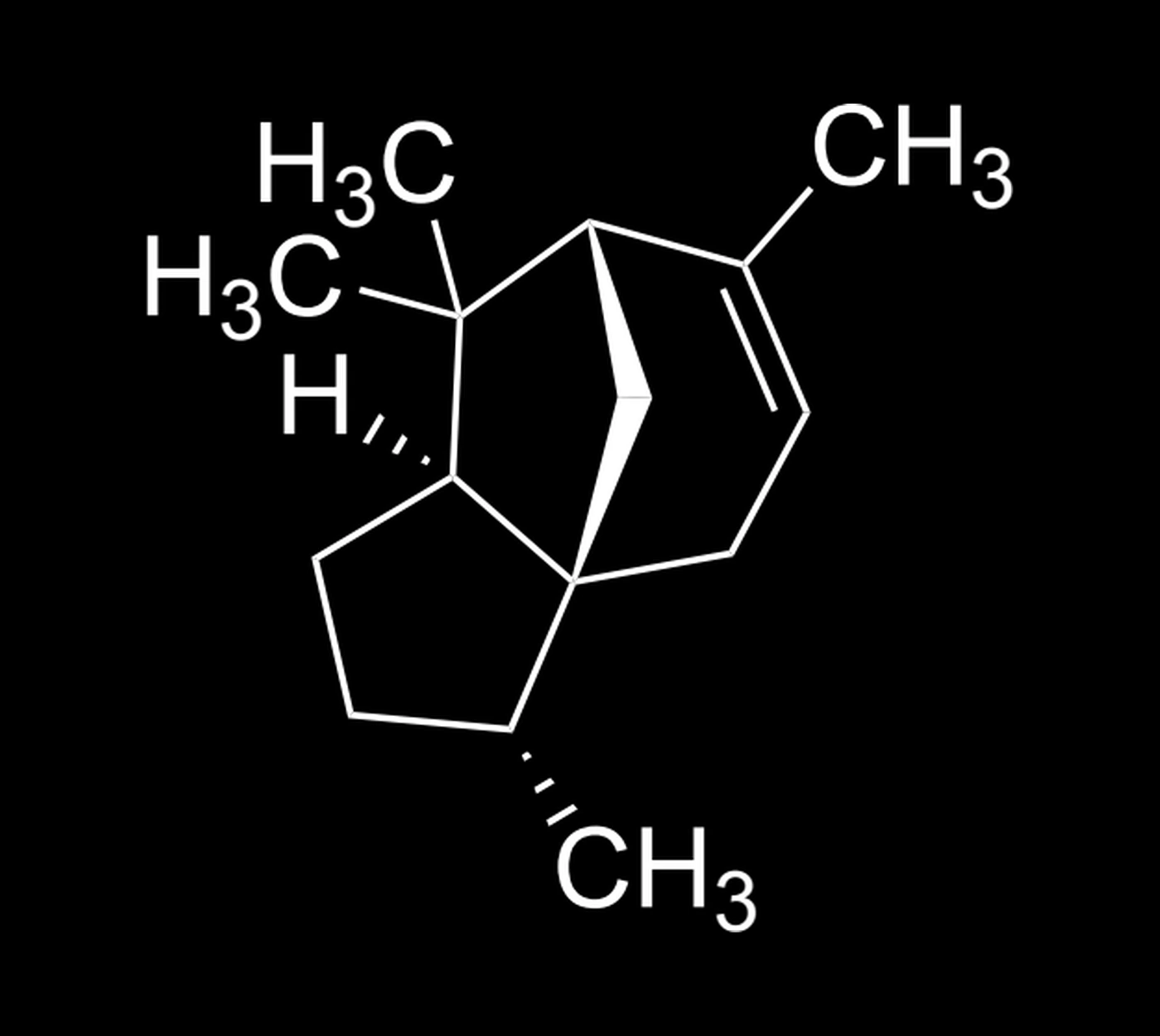
- Molecular formula
- C15H24
- Molecular weight
- 204.36 g mol−1
- CCDC accession
- 2565727 ↗
- Host
- Pd6L4 cage 1a
- Compound in publication
- 5
MOLECULAR HISTORY
From a cedar-oil skeleton to the unmodified guest
Cedrene’s structure emerged in stages. First came a carbon skeleton, then a synthesis that put it to the test, and finally stereochemical arguments built from chemical transformations and optical measurements. The 2026 work adds the unmodified molecule’s crystal structure to that chain of evidence.
- 1953
- 1955
- 1961
Stereochemistry through chemical correlation
The detailed cedrol study established stereochemistry through synthesis and chemical relationships. Its absolute-configuration argument used a cedrol-derived cedrene isomer, conversion to norcedranone, and the product’s Cotton effect—evidence obtained through transformations and optical measurements.3
- 2026
Cedrene itself enters the crystal record
Cedrene now reaches the crystal without a chemical change to the analyte. Paired with phenanthrene in cage 1a, its framework is resolved directly; a second measurement in chiral cage 1b strengthens absolute-configuration assignment. The published study reports the unmodified molecule’s first crystal structure.4
WHY THIS STRUCTURE MATTERS
Chemical correlations and synthesis had established cedrene’s structure. The 2026 measurements add direct crystallographic evidence for the unmodified hydrocarbon and strengthen its absolute-configuration assignment using a chiral host.
References
- G. Stork; R. Breslow. “The Structure of Cedrene.” J. Am. Chem. Soc. 1953, 75, 3291. DOI 10.1021/ja01109a524 ↗
- G. Stork; F. H. Clarke, Jr. “The Total Synthesis of Cedrol and Cedrene.” J. Am. Chem. Soc. 1955, 77, 1072–1073. DOI 10.1021/ja01609a104 ↗
- G. Stork; F. H. Clarke, Jr. “Cedrol: Stereochemistry and Total Synthesis.” J. Am. Chem. Soc. 1961, 83, 3114–3125. DOI 10.1021/ja01475a030 ↗
- W. He; L. Soliman; H. Takezawa; M. Fujita. “Expanding the Chemical Space of Analytes in the 2G Crystalline Sponge Method: Size-Compensation Strategy for the Structural Analysis of Low-Polarity Small Molecules.” Angew. Chem. Int. Ed. 2026, e4748505. DOI 10.1002/anie.4748505 ↗
Crystal records in this study
| Host | Modulator | CCDC | SI table |
|---|---|---|---|
| Standard cage 1a | Phenanthrene 2a | 2565727 | S2 |
SOURCE PUBLICATION
Expanding the Chemical Space of Analytes in the 2G Crystalline Sponge Method: Size-Compensation Strategy for the Structural Analysis of Low-Polarity Small Molecules
W. He, L. Soliman, H. Takezawa, M. Fujita
Angew. Chem. Int. Ed. 2026, e4748505.
First published: 20 October 2026 · Early View
DOI 10.1002/anie.4748505 ↗Enhanced absolute-configuration determination
The known absolute configuration of the chiral diamine ligand at each Pd center of the cage serves as an internal stereochemical reference for comparison with the guest. Introducing chirality into the host framework also improves absolute-structure discrimination by anomalous scattering, as assessed by the Flack parameter below.
Chiral cage 1b · CCDC 2565758 ↗
Flack x = 0.080(8) (Parsons; CIF)