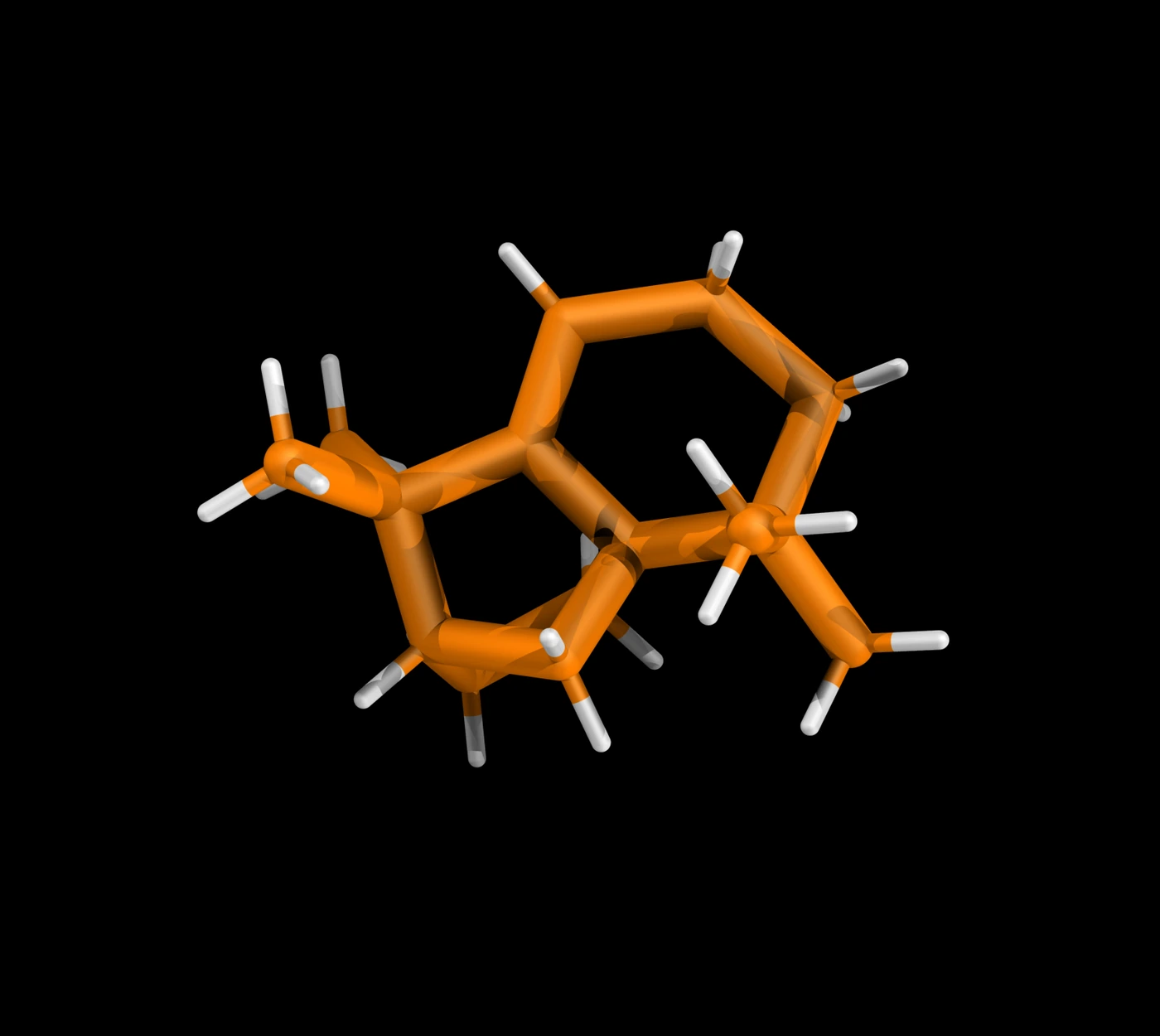
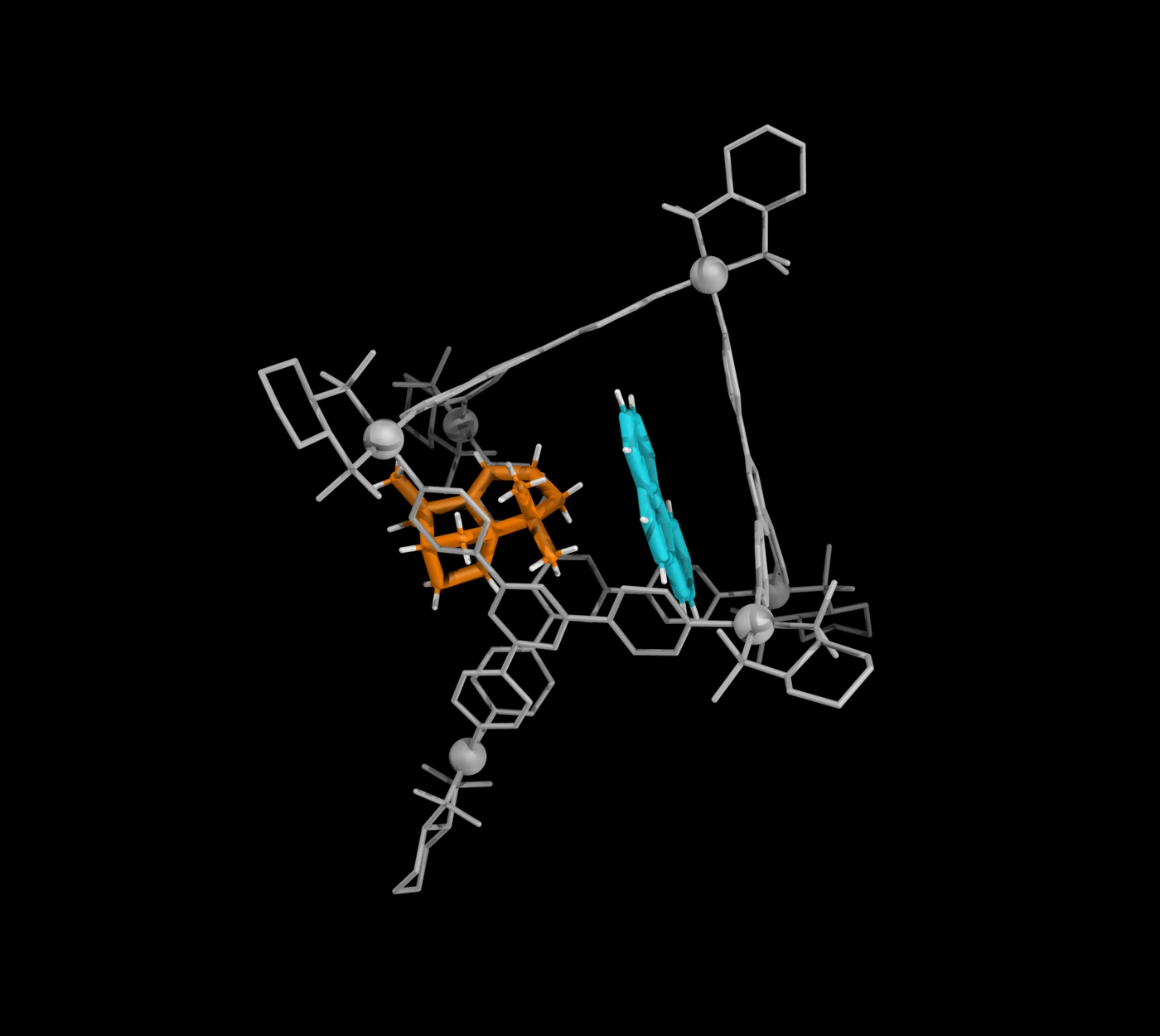
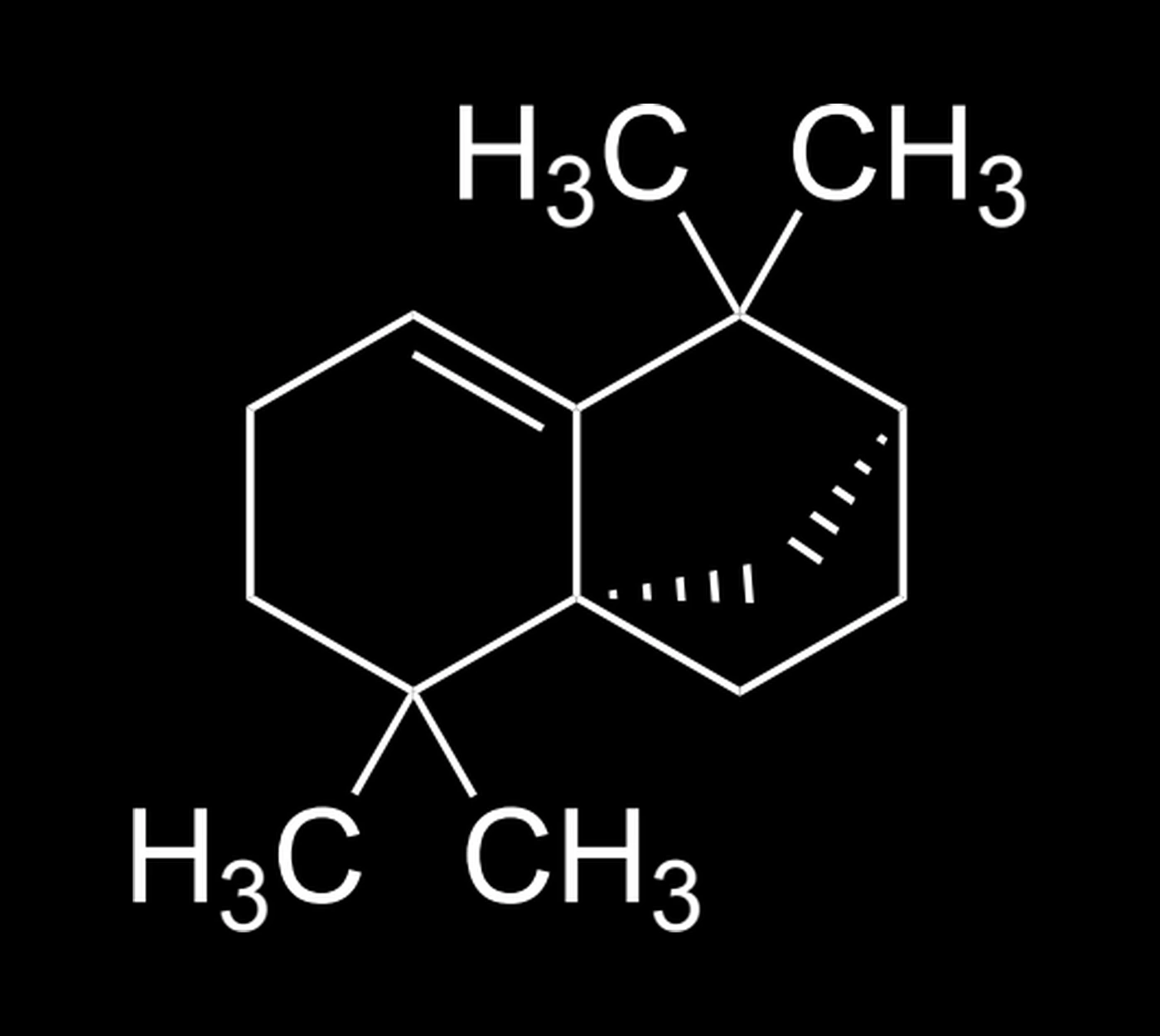
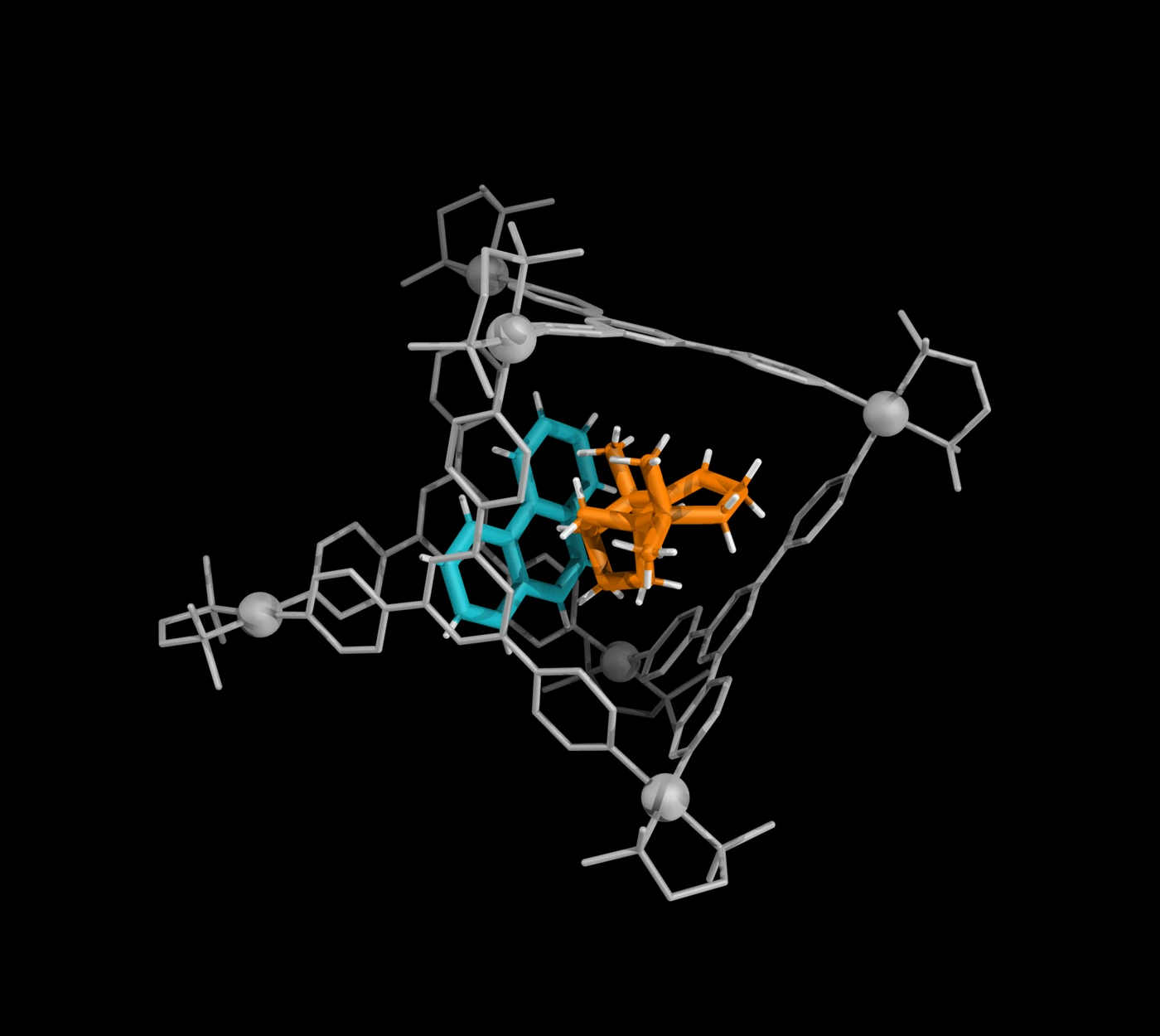
(−)-Isolongifolene (compound 7) was structurally analyzed using cage 1a and phenanthrene (2a) in the size-compensation strategy for low-polarity small molecules.
G077 · Sesquiterpenoid
(−)-Isolongifolene
C15H24 · 204.36 g mol−1
First crystal structure · Reported for the unmodified analyte in this study → · Read the story ↓
INTERACTIVE 3D STRUCTURE
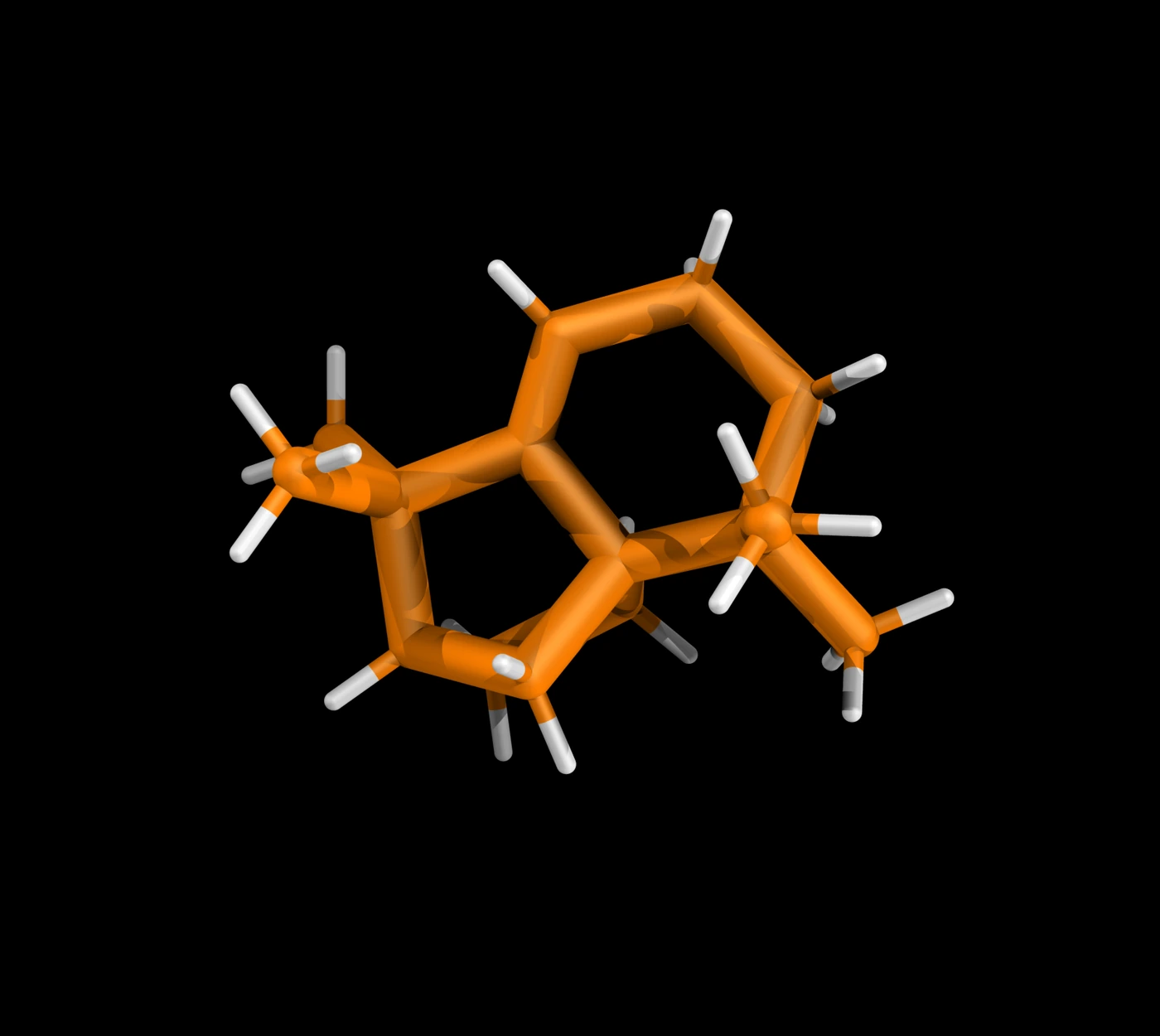
Explore (−)-Isolongifolene in its crystalline sponge
Drag to rotate, scroll to zoom, switch the cage on or off, and export the current view.
CHONCagePhenanthrene 2a
- Molecular formula
- C15H24
- Molecular weight
- 204.36 g mol−1
- CCDC accession
- 2565729 ↗
- Host
- Pd6L4 cage 1a
- Compound in publication
- 7
MOLECULAR HISTORY
From a rearrangement product to a resolved guest
An acid can turn longifolene into a different bridged hydrocarbon: isolongifolene. Establishing the product’s structure also raised a question about the rearrangement that formed it. Chemical correlations and isotope experiments traced that story; the 2026 work adds a crystal structure of the unchanged molecule.
- 1970
The rearranged skeleton is established
Ranganathan and colleagues reported a detailed structural study of isolongifolene. Chemical transformations, optical rotations and comparisons with longifolene connected the rearranged skeleton to its precursor and revealed how partial racemization complicated the historical samples.1
- 1980
Isotope labels trace the pathway
Yadav, Nayak and Sukh Dev tested competing rearrangement pathways by following deuterium labels. Their results supported an exo,exo methyl migration, clarifying how longifolene becomes isolongifolene and extending the structural story into a test of the reaction mechanism.2
- 2026
The unmodified guest is resolved
The rearrangement product can now be examined as an unmodified guest in a crystal. Paired with phenanthrene inside cage 1a, isolongifolene is resolved directly; a further measurement in chiral cage 1b strengthens its absolute-configuration assignment. The published study reports this as its first crystal structure.3
WHY THIS STRUCTURE MATTERS
Earlier work explained the molecule through reactions, rotations and labelled atoms. The host–guest crystal adds direct structural coordinates for unmodified isolongifolene, with standard and chiral cages providing two measured views of one analyte.
References
- R. Ranganathan; U. R. Nayak; T. S. Santhanakrishnan; Sukh Dev. “Studies in sesquiterpenes—XL: Isolongifolene (part 1): Structure.” Tetrahedron 1970, 26, 621–630. DOI 10.1016/S0040-4020(01)97855-X ↗
- J. S. Yadav; U. R. Nayak; Sukh Dev. “Studies in sesquiterpenes—LV: Isolongifolene (part 6): Mechanism of rearrangement of longifolene to isolongifolene—I.” Tetrahedron 1980, 36, 309–315. DOI 10.1016/0040-4020(80)80020-2 ↗
- W. He; L. Soliman; H. Takezawa; M. Fujita. “Expanding the Chemical Space of Analytes in the 2G Crystalline Sponge Method: Size-Compensation Strategy for the Structural Analysis of Low-Polarity Small Molecules.” Angew. Chem. Int. Ed. 2026, e4748505. DOI 10.1002/anie.4748505 ↗
Crystal records in this study
| Host | Modulator | CCDC | SI table |
|---|---|---|---|
| Standard cage 1a | Phenanthrene 2a | 2565729 | S4 |
SOURCE PUBLICATION
Expanding the Chemical Space of Analytes in the 2G Crystalline Sponge Method: Size-Compensation Strategy for the Structural Analysis of Low-Polarity Small Molecules
W. He, L. Soliman, H. Takezawa, M. Fujita
Angew. Chem. Int. Ed. 2026, e4748505.
First published: 20 October 2026 · Early View
DOI 10.1002/anie.4748505 ↗Enhanced absolute-configuration determination
The known absolute configuration of the chiral diamine ligand at each Pd center of the cage serves as an internal stereochemical reference for comparison with the guest. Introducing chirality into the host framework also improves absolute-structure discrimination by anomalous scattering, as assessed by the Flack parameter below.
Chiral cage 1b · CCDC 2565760 ↗
Flack x = 0.098(8) (Parsons; CIF)