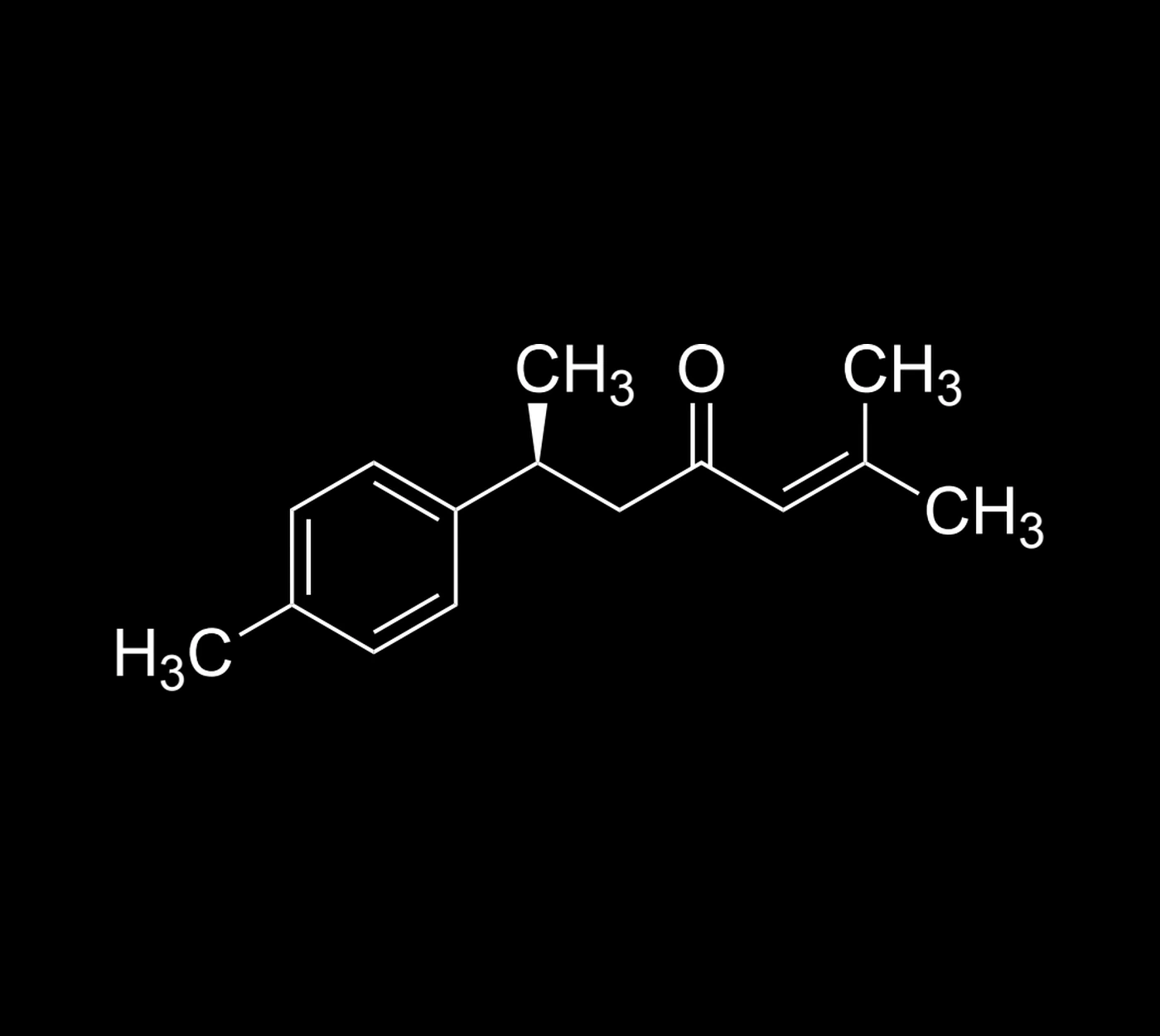
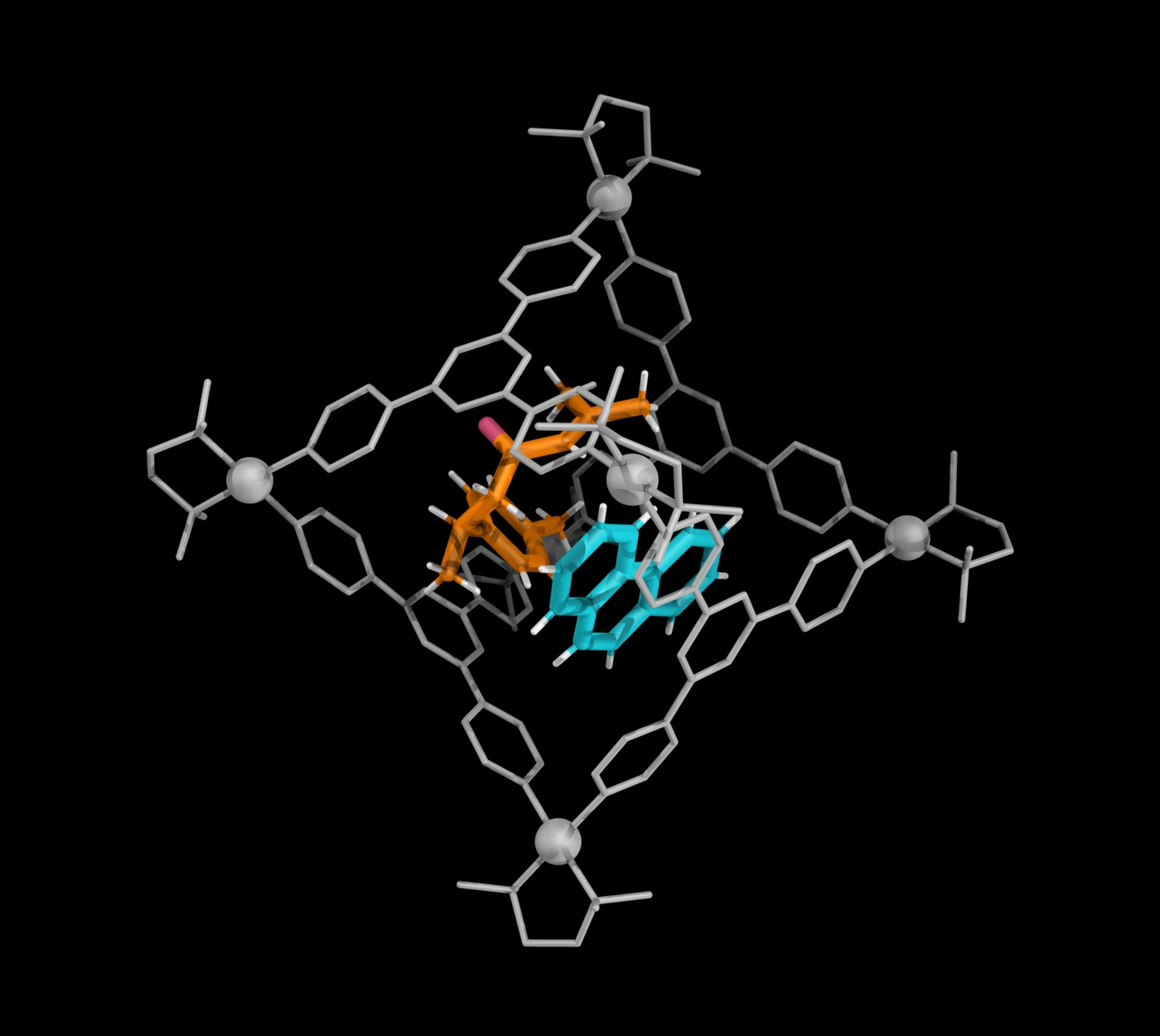
(+)-ar-Turmerone (compound 26) was structurally analyzed using cage 1a and phenanthrene (2a) in the size-compensation strategy for low-polarity small molecules.
G096 · Sesquiterpenoid
(+)-ar-Turmerone
C15H20O · 216.32 g mol−1
First crystal structure · Reported for the unmodified analyte in this study → · Read the story ↓
INTERACTIVE 3D STRUCTURE
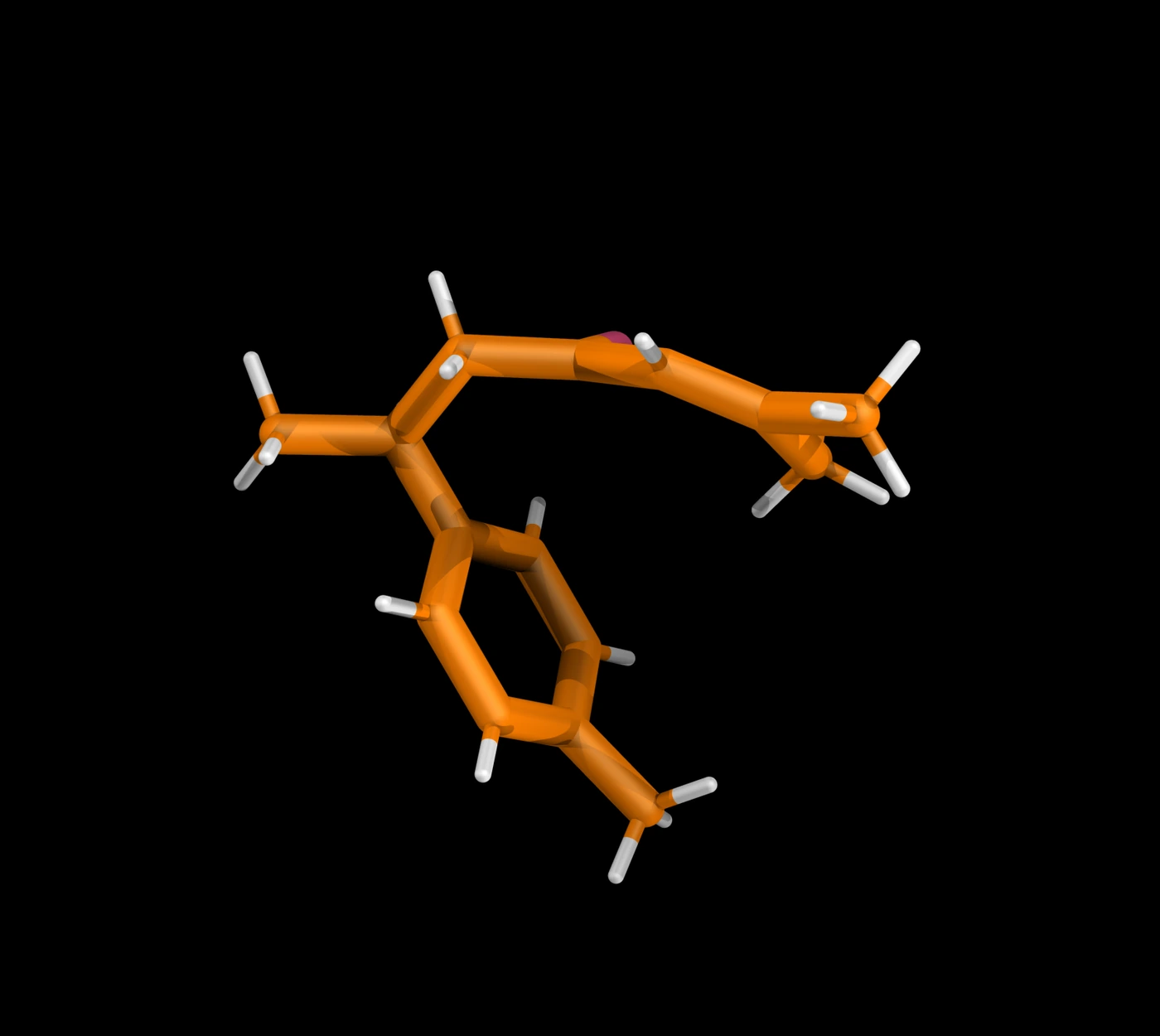
Explore (+)-ar-Turmerone in its crystalline sponge
Drag to rotate, scroll to zoom, switch the cage on or off, and export the current view.
CHONCagePhenanthrene 2a
- Molecular formula
- C15H20O
- Molecular weight
- 216.32 g mol−1
- CCDC accession
- 2565751 ↗
- Host
- Pd6L4 cage 1a
- Compound in publication
- 26
MOLECULAR HISTORY
From optical rotation to a crystal view of (+)-ar-turmerone
The stereochemical history of (+)-ar-turmerone precedes its present crystal structure by decades. Early researchers followed chemical transformations and optical behavior to establish its configuration; asymmetric synthesis later built the same named enantiomer. The new host–guest structure adds crystallographic observation of the unchanged molecule to that chain of chemical evidence.
- 1964
Configuration is traced through chemical change
Honwad and Rao investigated the absolute configuration of (+)-ar-turmerone through a hydrocarbon derived from it. Optical rotatory dispersion supplied their main evidence, supported by molecular rotations of related acid and alcohol products. The assignment therefore connected the parent molecule to experimentally examined chemical transformations.1
- 1979
Asymmetric synthesis reaches the positive enantiomer
Meyers and Smith reported a total asymmetric synthesis of (+)-ar-turmerone using a chiral oxazoline. This provided a constructive route to the named enantiomer, complementing the earlier assignment based on chemical correlation and optical measurements. Synthesis and structure determination contributed different evidence about the same molecular identity.2
- 2026
The unchanged analyte is held in a crystal
The published study combines (+)-ar-turmerone with phenanthrene inside cage 1a and determines its host–guest crystal structure. The authors report the first such crystallographic characterization of the unmodified parent analyte. The result joins earlier chiroptical and synthetic history with an experimentally resolved crystalline arrangement.3
WHY THIS STRUCTURE MATTERS
The new structure adds a view of unmodified (+)-ar-turmerone inside its host. Configuration studies and asymmetric synthesis had already established substantial evidence about this molecular identity; the 2026 crystallographic result adds another experimental perspective.
References
- Honwad, V. K.; Rao, A. S. “Terpenoids—LX: Absolute configuration of ar-turmerone.” Tetrahedron 1964, 20, 2921–2925. DOI 10.1016/S0040-4020(01)98513-8 ↗
- Meyers, A. I.; Smith, R. K. “A total asymmetric synthesis of (+)-ar-turmerone.” Tetrahedron Letters 1979, 20, 2749–2752. DOI 10.1016/S0040-4039(01)86405-4 ↗
- W. He; L. Soliman; H. Takezawa; M. Fujita. “Expanding the Chemical Space of Analytes in the 2G Crystalline Sponge Method: Size-Compensation Strategy for the Structural Analysis of Low-Polarity Small Molecules.” Angew. Chem. Int. Ed. 2026, e4748505. DOI 10.1002/anie.4748505 ↗
Crystal records in this study
| Host | Modulator | CCDC | SI table |
|---|---|---|---|
| Standard cage 1a | Phenanthrene 2a | 2565751 | S23 |
SOURCE PUBLICATION
Expanding the Chemical Space of Analytes in the 2G Crystalline Sponge Method: Size-Compensation Strategy for the Structural Analysis of Low-Polarity Small Molecules
W. He, L. Soliman, H. Takezawa, M. Fujita
Angew. Chem. Int. Ed. 2026, e4748505.
First published: 20 October 2026 · Early View
DOI 10.1002/anie.4748505 ↗