
01 / THE ENCOUNTER
Opposites attract.
Cage¹²⁺ · “sticker” anion⁴⁻
Loading crystal coordinates…
Structure note
Opening artwork: Michelangelo, The Creation of Adam · Wikimedia Commons (public-domain reproduction). Used as a visual metaphor, not a scientific mechanism.
Cage–“sticker” anion view from CCDC 2278396. Cages are grey-green; pyrene-tetrasulfonate “sticker” anions are blue. Real unit-cell translations and inversion symmetry are retained. The final view looks along a using orthographic projection. Solvent, nitrate, hydrogen atoms and minor disorder are omitted; this is not a pore-size calculation.
Concept: electrostatic attraction of highly charged partners and shape-directed stacking of the “sticker” anion against cage walls. Based on Wei He’s doctoral thesis, Chapter 1 pp. 10–11 and Chapter 2 pp. 20–23, and defense slides 10, 13–15. The assembly sequence is illustrative, not a measured crystallization trajectory. The crystal motif does not imply a 1:1 cage-to-“sticker” anion ratio.
He et al. · Nature Chemistry 2025 ↗02 / A PLACE FOR A GUEST
With a guest
Methylandrostenediol
Loading guest-loaded crystal…
Structure note
Methylandrostenediol is gold; cages are grey-green; resolved “sticker” anions are blue. CCDC 2357188, with its own experimental P1 unit cell and both independent cages. Guest positions are taken from this crystal, not inserted into the empty sponge lattice. The entire crystal is rigidly rotated to align its cage with the empty crystal; internal coordinates and unit-cell geometry are preserved. The final camera looks along the original crystallographic b axis to show the channels. All resolved guests remain visible; this is a projection of the selected model, not a solvent-accessible pore-size calculation.
The opening isolates one host–guest contact motif; it does not imply that the guest sits inside the cage. The animation is an illustrative assembly sequence, not an observed uptake or crystallization pathway. Major-occupancy heavy atoms and complete resolved guest components are shown. Solvent, nitrate, hydrogens, minor disorder and incomplete sulfonate components are omitted.
Explore Methylandrostenediol →Nature Chemistry 2025 ↗
03 / BEYOND THE SMALL MOLECULE
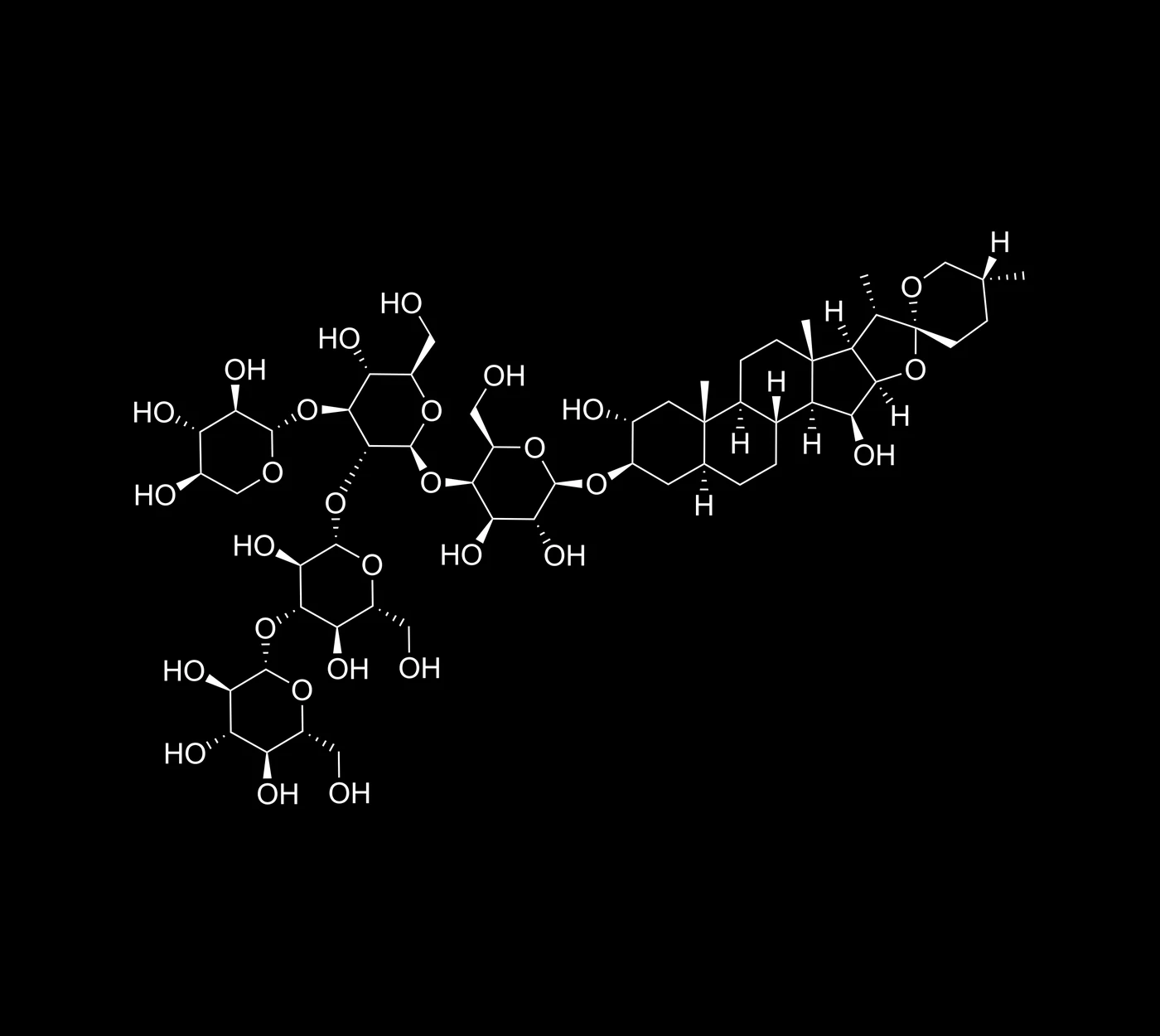
Even larger guest
Digitonin
Loading guest-loaded crystal…
Structure note
Digitonin is gold; cages are grey-green; resolved “sticker” anions are blue. CCDC 2357196, with its own experimental P1 unit cell and both independent cages. Guest positions are taken from this crystal, not inserted into the empty sponge lattice. Final view along a.
The opening shows isolated Digitonin approaching its primary cage, selected by the largest number of guest–host heavy-atom contacts within 4 Å, before reaching the experimental geometry. This illustrative motion does not imply complete encapsulation or a measured binding trajectory. The animation is an illustrative assembly sequence, not an observed uptake or crystallization pathway. The final close-up uses the existing 85-heavy-atom, 91-hydrogen guest model. One hydrogen in the molecular formula is absent from that model and has not been added. The selected Digitonin packing model includes all 85 heavy atoms (C56O29), including sugar sites refined at 0.3 occupancy; these are drawn fully for readability, not to imply full site occupancy. Host and anion sites use the major-occupancy model. Solvent, nitrate, hydrogens, minor disorder and incomplete sulfonate components are omitted.
Explore Digitonin →Nature Chemistry 2025 ↗