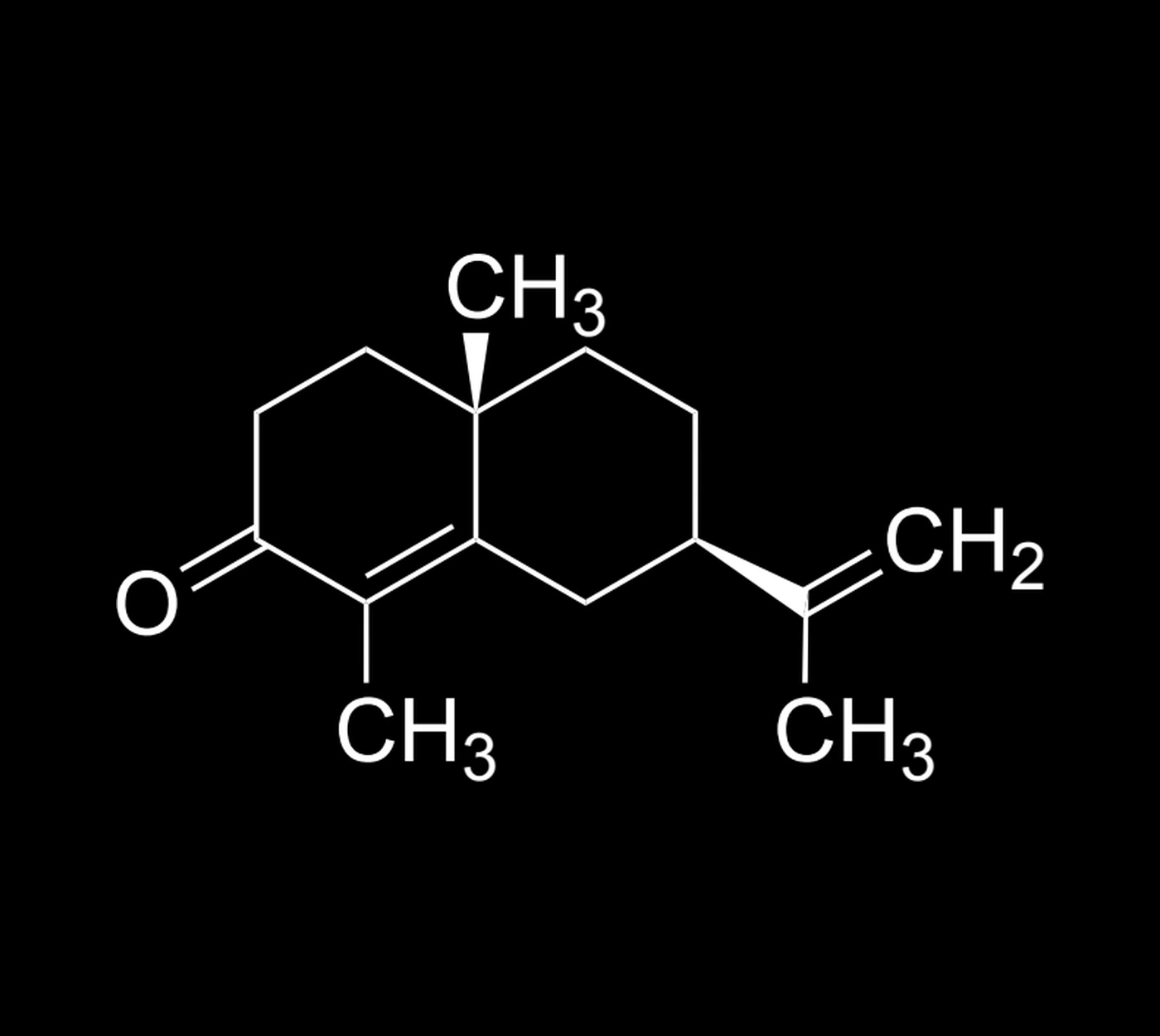
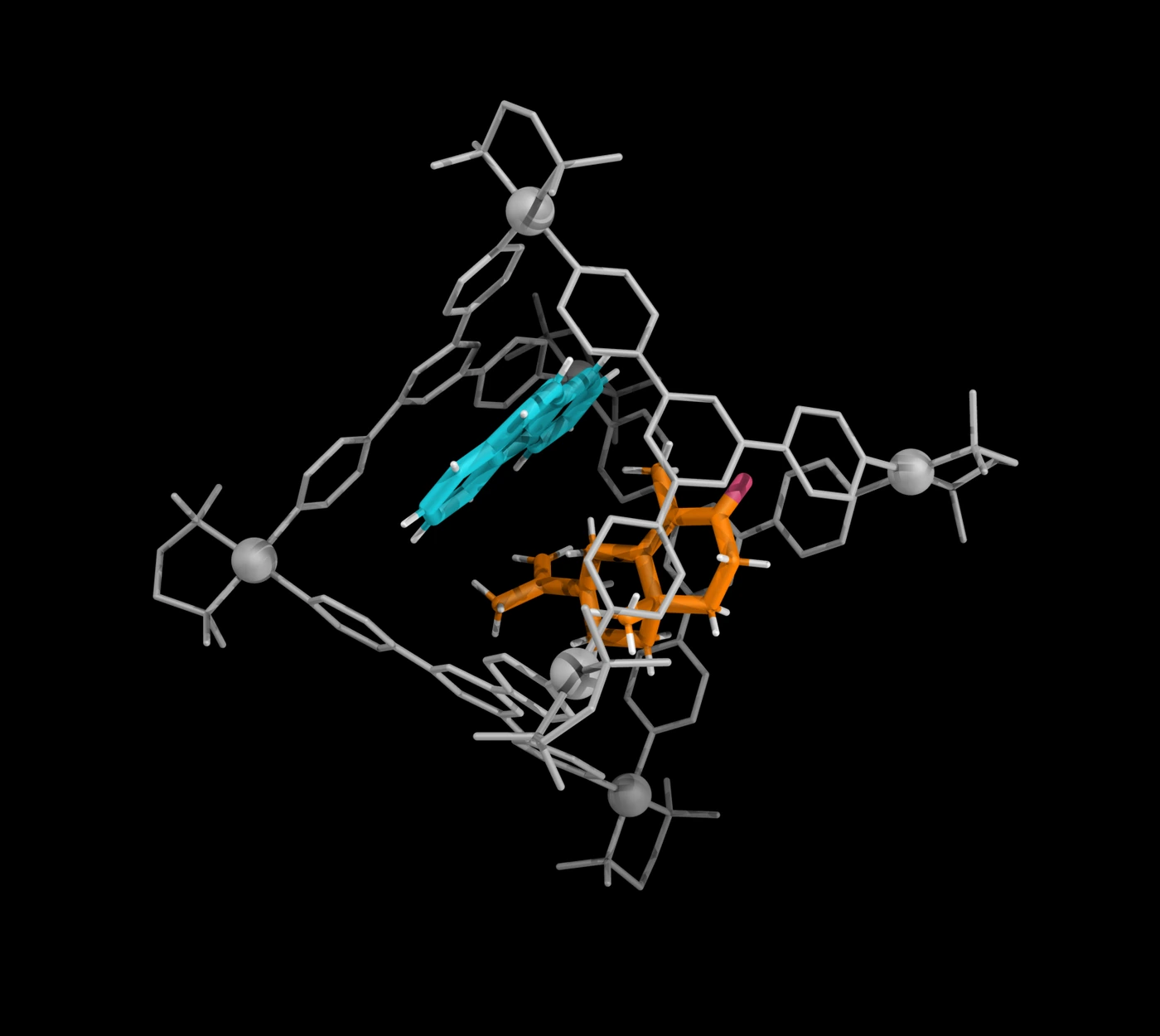
(+)-α-Cyperone (compound 22) was structurally analyzed using cage 1a and phenanthrene (2a) in the size-compensation strategy for low-polarity small molecules.
G092 · Sesquiterpenoid
(+)-α-Cyperone
C15H22O · 218.34 g mol−1
First crystal structure · Reported for the unmodified analyte in this study → · Read the story ↓
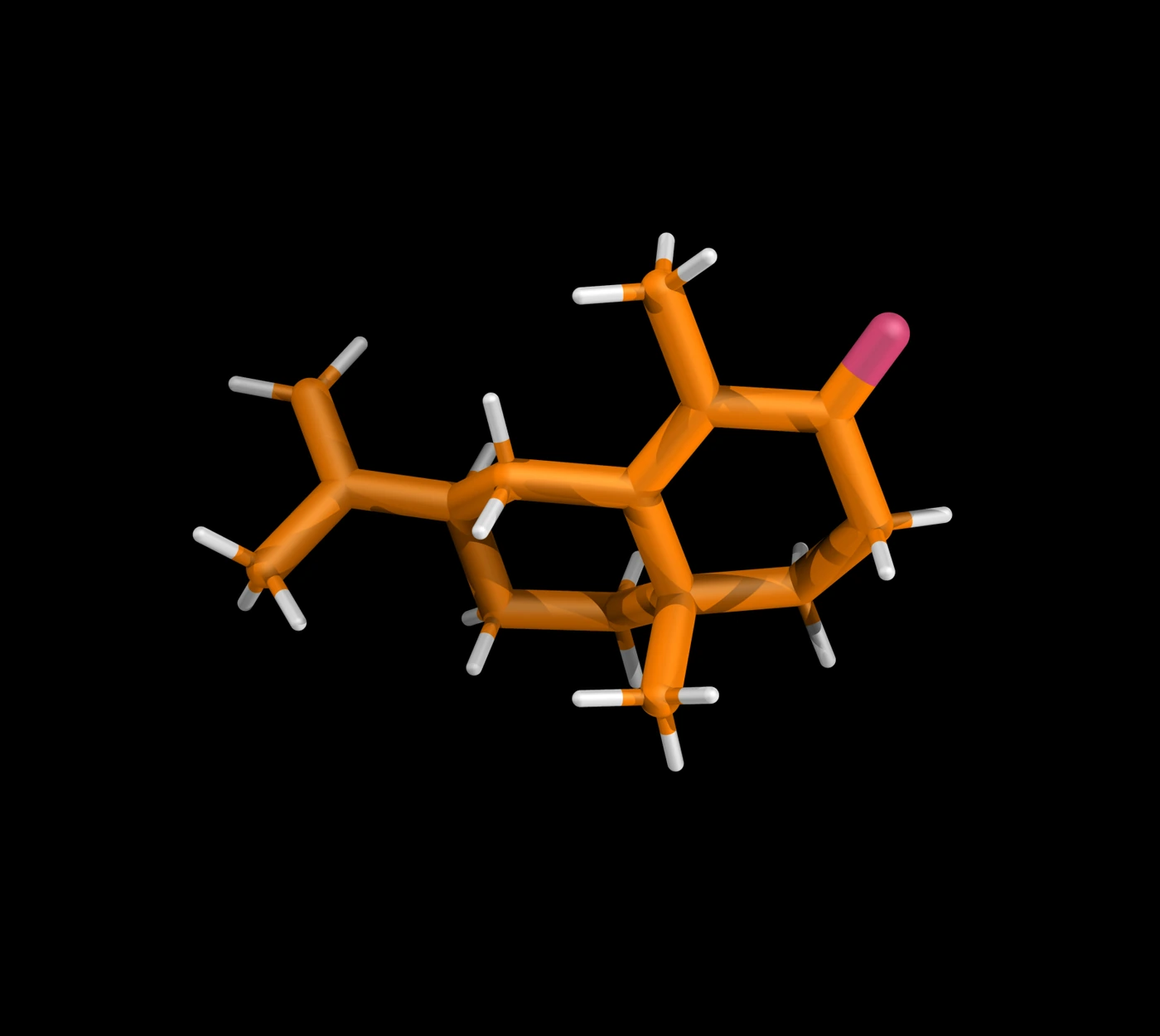
INTERACTIVE 3D STRUCTURE
Explore (+)-α-Cyperone in its crystalline sponge
Drag to rotate, scroll to zoom, switch the cage on or off, and export the current view.
CHONCagePhenanthrene 2a
- Molecular formula
- C15H22O
- Molecular weight
- 218.34 g mol−1
- CCDC accession
- 2565741 ↗
- Host
- Pd6L4 cage 1a
- Compound in publication
- 22
MOLECULAR HISTORY
From stereoisomer synthesis to a crystal view of (+)-α-cyperone
For α-cyperone, reproducing the carbon skeleton was only part of the structural problem: the natural product had to be distinguished from its mirror image and epimers. Successive syntheses made those distinctions explicit. The present host–guest structure adds a crystallographic view of the unchanged analyte to that established stereochemical record.
- 1955
Natural cyperone and its stereoisomers
Howe and McQuillin reported syntheses of natural (+)-α-cyperone, its enantiomorph and an epimer in their investigation of cyperone’s structure. Preparing these alternatives made stereochemistry central to the comparison: compounds sharing the same basic skeleton could still represent different molecular identities.1
- 1993
Asymmetric catalysis supplies another route
A later synthesis reached homochiral α-cyperone in five steps from achiral oxycarvone. Its selectivity came from a phenylalanine-catalyzed intramolecular aldol reaction. The molecule had become a target for controlling how chirality is created during synthesis, extending the earlier work that distinguished its stereoisomers.2
- 2026
Crystallography observes the parent analyte
The published study co-encapsulates (+)-α-cyperone with phenanthrene in cage 1a and determines the resulting host–guest crystal structure. The authors identify it among the parent analytes without a previously reported crystal structure. This places an unchanged molecule, long accessible through synthesis, in an experimentally determined crystalline environment.3
WHY THIS STRUCTURE MATTERS
The 2026 result connects a long synthetic record with a crystal model of the unmodified analyte. It complements earlier chemical evidence for molecular identity and stereochemistry with an experimentally resolved structure inside the molecular host.
References
- Howe, R.; McQuillin, F. J. “The structure of cyperone. Part IV. The synthesis of (natural)(+)-α-cyperone, its enantiomorph, and an epimer.” Journal of the Chemical Society 1955, 2423–2428. DOI 10.1039/JR9550002423 ↗
- Agami, C.; Kadouri-Puchot, C.; Le Guen, V. “Synthesis of homochiral α-cyperone via enantioselective catalysis.” Tetrahedron: Asymmetry 1993, 4, 641–644. DOI 10.1016/S0957-4166(00)80168-8 ↗
- W. He; L. Soliman; H. Takezawa; M. Fujita. “Expanding the Chemical Space of Analytes in the 2G Crystalline Sponge Method: Size-Compensation Strategy for the Structural Analysis of Low-Polarity Small Molecules.” Angew. Chem. Int. Ed. 2026, e4748505. DOI 10.1002/anie.4748505 ↗
Crystal records in this study
| Host | Modulator | CCDC | SI table |
|---|---|---|---|
| Standard cage 1a | Phenanthrene 2a | 2565741 | S19 |
SOURCE PUBLICATION
Expanding the Chemical Space of Analytes in the 2G Crystalline Sponge Method: Size-Compensation Strategy for the Structural Analysis of Low-Polarity Small Molecules
W. He, L. Soliman, H. Takezawa, M. Fujita
Angew. Chem. Int. Ed. 2026, e4748505.
First published: 20 October 2026 · Early View
DOI 10.1002/anie.4748505 ↗