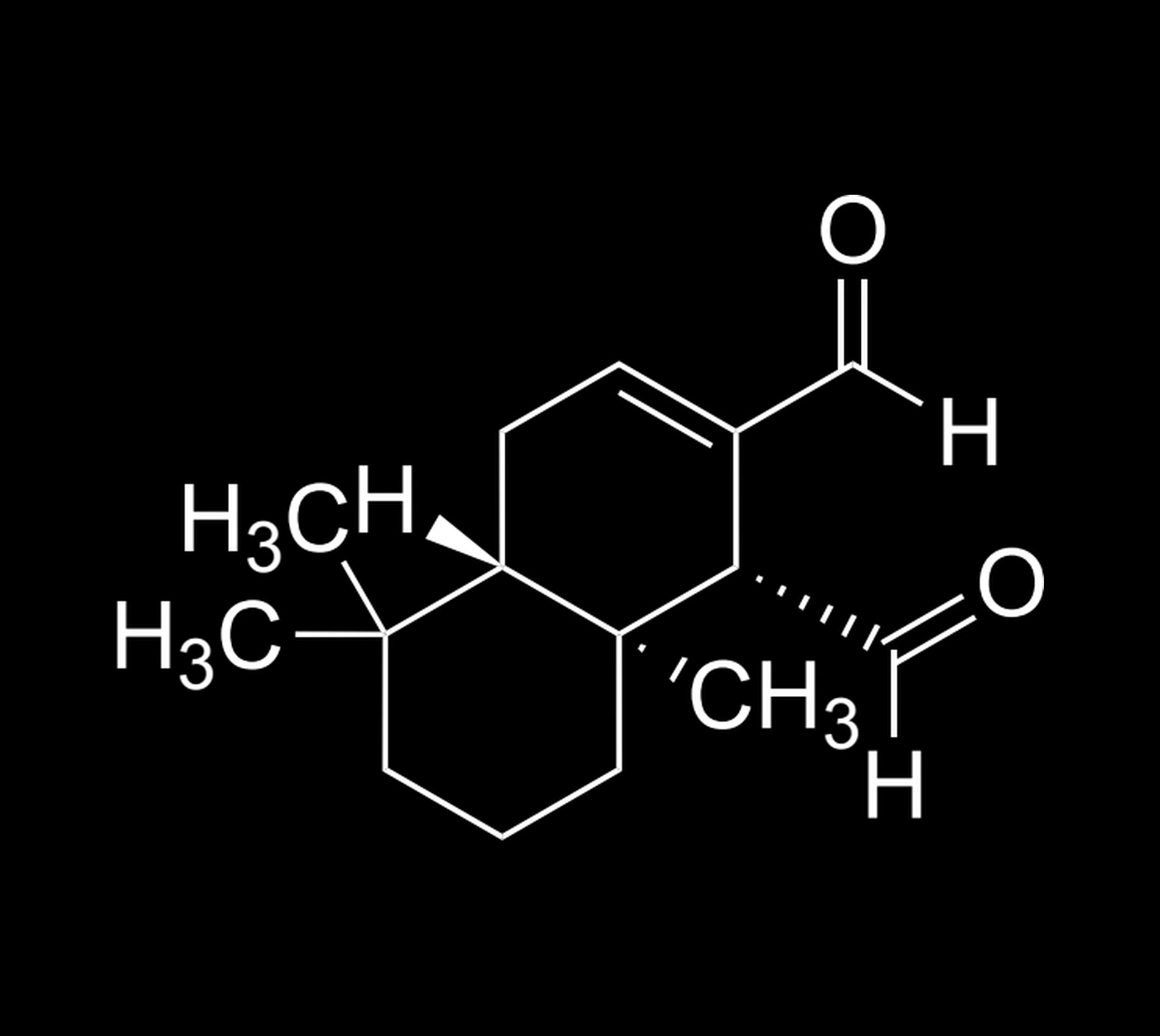
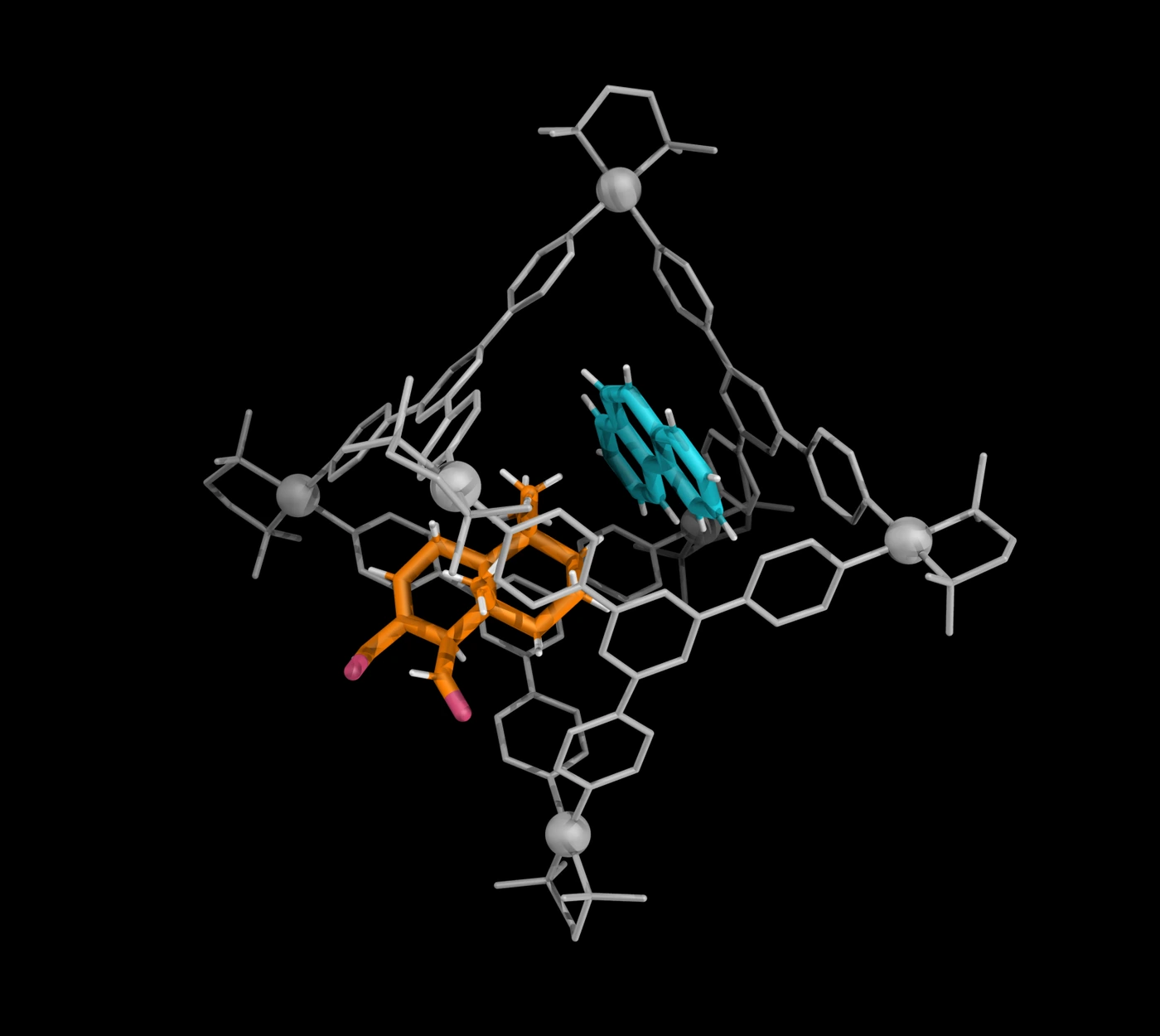
Polygodial (compound 23) was structurally analyzed using cage 1a and phenanthrene (2a) in the size-compensation strategy for low-polarity small molecules.
G093 · Sesquiterpenoid
Polygodial
C15H22O2 · 234.34 g mol−1
First crystal structure · Reported for the unmodified analyte in this study → · Read the story ↓
INTERACTIVE 3D STRUCTURE
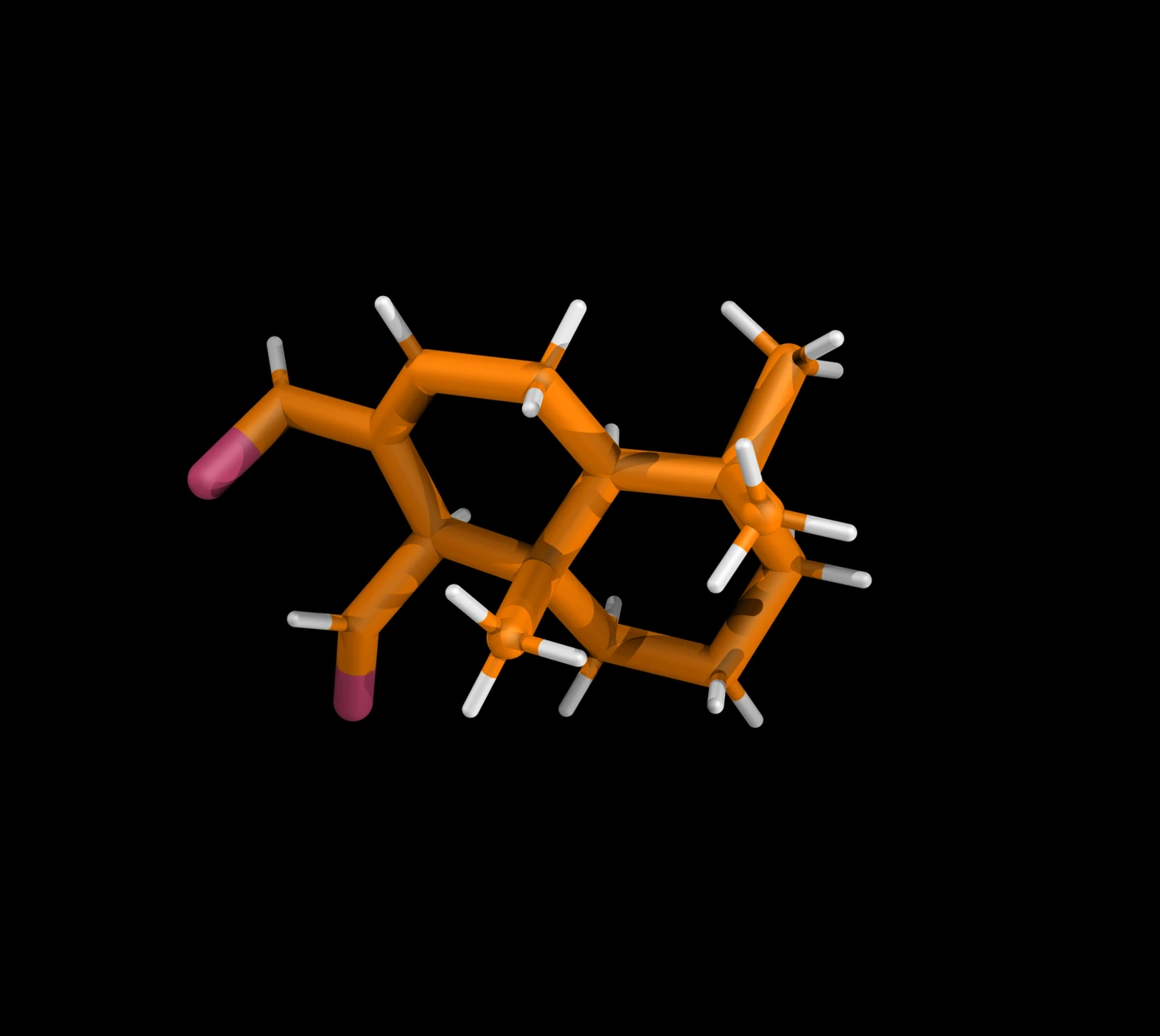
Explore Polygodial in its crystalline sponge
Drag to rotate, scroll to zoom, switch the cage on or off, and export the current view.
CHONCagePhenanthrene 2a
- Molecular formula
- C15H22O2
- Molecular weight
- 234.34 g mol−1
- CCDC accession
- 2565742 ↗
- Host
- Pd6L4 cage 1a
- Compound in publication
- 23
MOLECULAR HISTORY
From a pungent plant constituent to its host–guest crystal structure
Polygodial entered the literature as a pungent substance from Polygonum hydropiper. Its pair of aldehyde groups and drimane skeleton then became a problem that synthetic chemists could deliberately reconstruct. The present crystal structure adds another kind of evidence: a view of the chemically unchanged dialdehyde held inside a molecular cage.
- 1962
A pungent substance receives a structure
Barnes and Loder isolated polygodial from Polygonum hydropiper and identified it as a new sesquiterpene dialdehyde, drim-7-en-11,12-dial. Their study connected the plant’s pungent constituent with a defined molecular framework related to the sesquiterpene lactones known from Drimys species.1
- 1983
A synthetic route builds the drimane framework
Hollinshead, Ley and colleagues developed a Diels–Alder route to several drimane natural products, including polygodial. Their sequence converted a cycloaddition product into a trans-fused decalin intermediate and then a common diol. This brought polygodial into a shared synthetic framework with cinnamolide, drimenin and related compounds.2
- 2026
The dialdehyde is observed without derivatization
Polygodial is analyzed in the published study as an unchanged guest paired with phenanthrene inside cage 1a. The authors report its first crystal-structure characterization in this host–guest form. The measurement adds a crystalline structural model to the earlier evidence from isolation, chemical assignment and synthesis.3
WHY THIS STRUCTURE MATTERS
Polygodial’s identity was established through earlier chemistry. The new contribution is the crystal structure of the unmodified dialdehyde within the host, allowing its molecular arrangement to be examined without converting its aldehyde groups into a crystalline derivative.
References
- Barnes, C. S.; Loder, J. W. “The Structure of Polygodial: A New Sesquiterpene Dialdehyde from Polygonum hydropiper L.” Australian Journal of Chemistry 1962, 15, 322–327. DOI 10.1071/CH9620322 ↗
- Hollinshead, D. M.; Howell, S. C.; Ley, S. V.; Mahon, M.; Ratcliffe, N. M.; Worthington, P. A. “The Diels–Alder route to drimane related sesquiterpenes; synthesis of cinnamolide, polygodial, isodrimeninol, drimenin and warburganal.” Journal of the Chemical Society, Perkin Transactions 1, 1983, 1579–1589. DOI 10.1039/P19830001579 ↗
- W. He; L. Soliman; H. Takezawa; M. Fujita. “Expanding the Chemical Space of Analytes in the 2G Crystalline Sponge Method: Size-Compensation Strategy for the Structural Analysis of Low-Polarity Small Molecules.” Angew. Chem. Int. Ed. 2026, e4748505. DOI 10.1002/anie.4748505 ↗
Crystal records in this study
| Host | Modulator | CCDC | SI table |
|---|---|---|---|
| Standard cage 1a | Phenanthrene 2a | 2565742 | S20 |
SOURCE PUBLICATION
Expanding the Chemical Space of Analytes in the 2G Crystalline Sponge Method: Size-Compensation Strategy for the Structural Analysis of Low-Polarity Small Molecules
W. He, L. Soliman, H. Takezawa, M. Fujita
Angew. Chem. Int. Ed. 2026, e4748505.
First published: 20 October 2026 · Early View
DOI 10.1002/anie.4748505 ↗